
Humility - war and peace
"We should learn to view ourselves with a sense of proportion and Christian humility before the enormous complexity of the world"

Humility is not thinking less of yourself, it’s thinking of yourself less. - C.S. Lewis
There were three of us going to USMC Quantico that summer - Larry, Jim and me. We were students at Penn State. We were placed in different training units so we didn't see each other that summer. Larry and I had spent some time preparing by running together. I also had a number of friends who were in the Army ROTC Ranger unit on campus. There was a general assessment among us that Jim would get people killed if he became an officer. We experienced him as arrogant. He had an inflated sense of his abilities. He seemed to lack humility, though that word would not have come to us back then. We were very young. We didn’t really know much of anything about war. But we did know a lack of humility when we saw it.
So, some random thoughts on humility and war.
Humility in the military
We joined the Marine Corps to be one of "The Few, The Proud", not one of "The Few, The Humble" yet humility is the most important principle we must practice. Colonel Donald J. Davis, U.S. Marine Corps
Acknowledging our limitations is necessary for people to work together effectively and make decisions under immense pressure. Humility helps leaders navigate the uncertainty and confusion of war, what von Clausewitz described as a “realm of uncertainty.” Ambiguity and personal limitations need to be accepted as the alternative to recklessness and the related disastrous outcomes which are brought about by our need to be right and protect our reputation. Without that acceptance we end up stubborn, impatient, and cut off. True in all fields, including the church.
Humility keeps leaders calm in the face of calamity by providing reflective context. Humility keeps leaders grounded when they are high, by reminding them of how they succeeded in the first place, to whom they should be grateful, and of what to be wary of. A healthy dose of humility slows us down, helps us think, encourages us to be open to new and innovative ideas, to grow and rectify our blind spots and weaknesses, and to listen across an organization. Humility tempers over-confident enthusiasm as it strengthens judgment. It humanizes leaders and creates conditions for effective and adaptive teams. It is the critical shadow leadership trait that enables the reflective development of all others. “The case for humble leadership,” Maj Dilan M. Swift, USMC
More - “True humility helps leaders navigate the fog of war” Army University Press, “Humility Is for Leaders” US Naval Institute
Just War Theory
The Episcopal Church has taken a rather traditional approach toward the just war theory. There is the issue of a decision to go to war (jus ad bellum) and then there are criteria regarding the conduct of the war (Jus in bello)
The decision to go to war (jus ad bellum)
Thomas Aquinas saw three things as necessary in a decision to go to war — legitimate authority, just cause, and right intention.
Legitimate authority (Auctoritas Principis) means that the war has been declared by a recognized authority, usually a sovereign state. In the United States decisions to take military action have in practice occurred most often under the President’s authority as the Commander-in-Chief with some conditions established by Congress (done hundreds of times by 43 presidents) and more rarely by a formal declaration of war by Congress (11 times between 1812 and 1942). The debate about executive vs. legislative authority is ongoing.
Just Cause (Causa Justa) those beginning the war must be seeking to avenge a wrong, Restore property that was illegitimately seized, and/or to protecting the innocent from harm
Right Intention (Intentio Recta) the impetus that initiates the war must be to promote good or avoid evil.
The conduct of the war (jus in bello)
The Episcopal Church has focused on two criteria “for discerning the justice of conduct in a war: proportionality and discrimination.”
Proportionality is about determining when a particular use of force—whether a weapon or a tactic—is likely to produce more harm than good. Will the outcome end aggression and correct a serious injustice? Is there a goal and possibility of establishing a stable and respectful post-war situation? And are those possibilities achievable without undue harm being caused by a particular act of force. You want to have a good result without an unacceptable degree of harm
Discrimination has meant that the action needed to be only against those involved in pursuing the war. We need to distinguish between legitimate military targets and civilians. The intentional targeting of the civilians is prohibited.
Problems
Just War theory does offer a normative framework. It gives us a place from which to engage the ethical issues of war.
Just war theory provides a framework for collaborative reflection by ethicists, religious leaders, diplomats, and public officials in thinking through the hard problems of securing the peace of order—the peace composed of justice, security, and freedom—in a disordered world: which is this world, this side of the Kingdom come in glory. Why Just War Theory Always Matters
However, the theory can be undermined by the immediate circumstances and conditions of a conflict. And there is a great deal of subjective judgment involved. Some say that no war fully meets all the just war criteria.
The details and facts matter. For example, the proportionality of force and the protection of noncombatants norms are rarely met in modern conflicts. Civilian casualties often account for 80-90% of deaths. In the case of the Hamas-Israel War we have seen the difficulty of applying the criterion of not intentionally attacking structures, such as hospitals, come up against the exception that such attacks are legitimate if the structures are used by the enemy for military purposes. There is a similar difficulty over the issue of civilian casualties. A strong case has been made that Israel has done more than any other nation has ever done to avoid civilian casualties by providing advance warning when an area is about to become a battleground, designating humanitarian corridors, and utilizing precision-guided munitions. The IDF has used phone calls, SMS, and leaflet drops to advise civilians to evacuate targeted areas and has paused operations to allow for civilian movement. Others make the case that there are simply too many civilians who have been killed, that all the acts to prevent civilian casualties do not offset the massive loss of life.
The Anabaptist tradition has questioned whether the theory really limits war or ends up justify it? Small numbers of Christians have thought it best to refrain from any participation in the affairs of power and government. So, they step aside from the just war discussion. There is also the stance of Christian pacifism. The early church was broadly pacifist.
For a more thorough exclamation of just war theory see: The Just War Tradition (Episcopal Church site), Understanding Just War Theory w/ Fr. Gregory Pine, O.P.,
Humility and war
We see humility whenever there is reflection involved as people engage the work of securing a just peace. It is significant whether done by an Army major general, the chair of a congressional committee or a parish study group. Reflection and pondering is humility.
We also see humility in all the acts of self-sacrifice, obedience to orders, officers caring for the welfare of those they lead, and soldiers who maintain some humanity toward the enemy. It’s there in the USMC norm that “Officers Eat Last,” a practice in which senior leaders wait until the most junior Marines have been served their food first. It’s a way of reinforcing the norm that the officer’s responsibility for their Marines’ well-being comes before their own. It's also there in the field as young lieutenants, have even younger Marines take off their boots and socks, bend down and examine their feet in an effort to head off frostbite and other damage.
The military has come to see that humility is a survival virtue. The nature of war is always changing. To be effective leaders must recognize their limitations — limitations of facts and knowledge, limitations of competence and character. The need is to listen to others, receive feedback, accept responsibility, develop trust, and continue to adapt. Last year I wrote about “Holy humility, confusion, and curiosity.” It was a reflection related to the Hamas-Israel War. I was looking at how difficult it was to get the facts and how our mental models sometimes make us blind. What military leaders experience is pretty much the same thing we all experienced. We are limited, and yes, we are self-absorbed. We're not going to see the “whole board.” We're going to make mistakes. So, maybe one thing we can do is take note of our own confusion. Access our curiosity. And above all put on humility and courage.
This kind of humility has value. From a Christian perspective its value is enhanced when it works in harmony with other virtues and gifts. That process results in wisdom. We all know Paul's understanding of what God is doing in our lives. As we grow into the full stature of Christ there is humility, gentleness, patience, forbearance born of love, eagerness to maintain unity in the bond of peace, truthfulness mediated in love, mutual kindness, tenderheartedness and forgiveness; and love, joy, peace, patience, kindness, generosity, faithfulness, gentleness and self-control. Then there are the Cardinal Virtues of prudence, justice, fortitude and temperance. When we consider humility in the military we also are likely to see other virtues and gifts in the person.
Admiral Chester Nimitz believed effectiveness comes through developing subordinates rather than “personal heroics” and that “intellectual humility enables learning from people you outrank”
And there are the moments of intervention.
Roddie Edmonds helped save the lives of 200 - 300 Jewish-American soldiers being held in a Nazi prisoner of war camp. Master sergeant Edmonds refused to obey an order by the camp’s commandant to identify Jewish-American soldiers. He said, “We are all Jews here. The German officer put a gun to his head. Edmonds said, “You can shoot me, but if you do, you’ll have to kill us all.” The officer then walked away. Decades after his death, Edmonds was posthumously recognized by Yad Vashem as “Righteous Among the Nations” in 2015, becoming the first U.S. soldier and one of five Americans to receive the honor for saving Jews during the Holocaust. Edmonds is to be awarded the Medal of Honor on March 2. - MORE
In 1968 when serving in Vietnam Warrant Officer Hugh Thompson Jr. and his crew saved the lives of many civilians during the My Lai massacre. He threatened and blocked the actions of other Americans, personally escorted civilians to safety, reported the events, and testified against the offenders. For years he was ostracized by many in the military and government. In 1998 Thompson and two other members of his crew were awarded the Soldier's Medal, the Army's highest award for bravery not involving direct contact with the enemy. Their actions later became a cornerstone of ethical training. - MORE
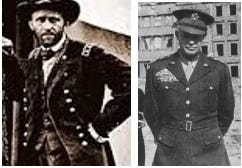
About Ulysses S. Grant
Grant’s humility was seen clearly in how he treated his subordinates. After he became the leader of all Union forces he stepped away from the comforts he would have if he had done his work from Washington, DC. Instead he stayed with the troops close to the battle. He slept on the ground with them and wore a private’s jacket instead of a formal general’s uniform. He encouraged and listened to alternative viewpoints from generals serving under him.
The best leaders throughout history, especially in the U.S. military, were humble. Humility helps us to not get lost in our own egos, to value others more dearly, and to better lead and serve. In the annals of American military history, it would be difficult to find a more humble leader than Ulysses S. Grant. Grant possessed an unusual amount of humility, knowledge of self, and a resultant ability to constantly acknowledge and learn from his own mistakes. To Lead, Be Humble — Ulysses S. Grant Also see Why humility is a strength and Leadership Traits of Ulysses S. Grant
About Dwight D. Eisenhower
Humility must always be the portion of any man who receives acclaim earned in blood of his followers and sacrifices of his friends. Conceivably a commander may have been professionally superior. He may have given everything of his heart and mind to meet the spiritual and physical needs of his comrades. He may have written a chapter that will glow forever in the pages of military history. Still, even such a man -- if he existed -- would sadly face the facts that his honors cannot hide in his memories the crosses marking the resting places of the dead. They cannot soothe the anguish of the widow or the orphan whose husband or father will not return. Dwight D. Eisenhower
At Normandy, General Eisenhower was willing to sacrifice control, authority, and even prestige by empowering and trusting his subordinate commanders to act independently. Hitler, on the other hand, consumed by hubris, inhibited his commanders’ ability to repel the invasion by demanding he be personally involved in tactical decision-making. As General Brown and Colonel Taradash argue: Humility serves as the catalyst for reducing the risk of friction inherent in command, and it can preserve perspective and self-control, potentially preventing the blind spots and trappings sometimes found in positions of power. “Humility Is for Leaders” US Naval Institute
Ike’s humility is seen in a message he wrote the evening before D-Day. He wrote two statements that night. One if things went well and the second if the invasion failed. The failure message was, “Our landings in the Cherbourg-Havre area have failed to gain a satisfactory foothold, and I have withdrawn the troops. My decision to attack at this time and place was based upon the best information available. The troops, the air, and the Navy did all that bravery and devotion to duty could do. If any blame or fault attaches to the attempt, it is mine alone.” Eisenhower took responsibility for what could have been one of the greatest military disasters in American history.
Eisenhower expressed his humility in other ways as well. Like Grant he rejected special treatment such as taking over villas in Italy. He thought they should be used by combat troops. He empowered subordinates and worked at giving others credit for their successful efforts..
Take Your Job Seriously, Never Yourself - Dwight D. Eisenhower
Also see “Facing Challenges With Adaptable Humility: Lessons From Dwight D. Eisenhower at Columbia University” and “It Is Mine Alone”
Humility
Humility is made visible when we have an accurate understanding of our strengths and limitations, a willingness to listen to others, being able to admit when we are mistaken, and attention to the well being and contributions of others.
Martin Buber said, “All journeys have secret destinations of which the traveler is unaware.” We hear that as an invitation to humility. When we plan, we are often tempted to think we control all these things. But there are always consequences we don’t anticipate. There are always challenges and possibilities that emerge during the process that we didn’t expect.
At the core of Christian humility is the sense that we are dependent on God. That God’s love nurtures and sustains us. There is also a pragmatic and realistic assessment of our condition, a recognition of our sin and limitations.
He has shown you, O mortal, what is good.
And what does the Lord require of you?
To act justly and to love mercy
and to walk humbly with your God. -Micah 6:8
A few takes on humility
God is on my side
Given the human capacity for self-centeredness - to see everything through our own narrow lens - all through history we have seen people believe that their country was engaged in a just war and doing it in a manner that was just. And there would be people among their enemies who would have the same belief about their country. So where do we go with that?
I think we find something of an answer in Kenneth Kirk’s view that it is in worship that we experience a way to manage and contain our self orientation, to the extent that that is possible. Kirk wrote, “The first practical question for Christian ethics is, therefore, how is this interestedness, unselfishness, to be attained? Once grant that moralism, or formalism, cannot bring the soul nearer to it, and there remains only one way – the way of worship. Worship lifts the soul out of its preoccupation with itself and his activities and centers its aspirations on God.” (More - “Worship lifts the soul out of its preoccupation with itself”)
Who am I?
That was a question asked by Pastor Dietrich Bonhoeffer when imprisoned by the Nazis. People told him that he “would bear the days of misfortune equably, smilingly, proudly, like one accustomed to win.” That he would speak to his “warders freely and friendly and clearly.” In his poem he went about what he knew of himself —
restless and longing and sick, like a bird in a cage,
struggling for breath, as though hands were compressing my throat,
yearning for colours, for flowers, for the voices of birds,
thirsting for words of kindness, for neighbourliness,
trembling with anger at despotism and petty humiliation,
Benedictine Spirituality
The word listen in Latin is audire. If we listen with full attention in which we are totally geared to listen, it’s called ob-audire, and that’s where the word obedience comes from. Jesus is the obedient one. That means he is total ear, totally open to the love of God. And if we are closed, and to the degree that we are closed, we are surdus. That is the Latin word for deaf. The more “deaf” we get, the more absurdus. Henri J.M. Nouwen
Saint Benedict described humility as a ladder with twelve rungs. The first is obedience. Obedience is a loving surrender of self-will to God. We see it in listening to one another in the community - “mutual obedience” - and to those in authority.
Benedict seeks a process of listening and response. It is a call for a timely response, without murmuring. It invites us into an active and empathic engagement or Ob-Audire. We are to be open to God’s word as heard in the community and the superior. We are invited to grasp the message and perspective of others. We begin with the assumption and stance of obedience. It’s not an easy pathway for an individualistic society.
In the life of a community a timely response will include a bit of pondering. Mary “pondering these things in her heart” and Joseph’s struggle (pondering) over her pregnancy being resolved in a dream. Both heard an angel and responded in obedience. There is a deep humility in such obedience. We begin with the stance of assuming we will obey. That stance sets up a process of appropriate reflection in which we seek to connect what we have heard to the circumstances of our life.
Our process of reflection may involve a general openness to the virtue of counsel or guidance. An openness to the Holy Spirit, an “energy not our own.” It is related to developing a capacity for listening and an inner silence. Or on occasion, it may involve some more discipline method such as Macquarrie’s compassionate thinking and/or responsible thinking. Processes of going out of oneself: of standing alongside the other person in thought and especially intercessory prayer and acting in a responsible manner toward others by taking into account their needs and claims. (See more in Compassionate thinking in the presence of God) - Reflection
This is part of how we open ourselves to spiritual maturity. We are not just follow rules but seeking the will of God in each situation. The process is often - hearing, reflecting, and acting. "Listen with the ear of your heart," is the opening line of the Rule of Saint Benedict. Benedict offers space for us to surrender our self-centeredness to a process in which the routines of daily life are made more intentional and prayerful.
The last, the 12th rung of the ladder, is the coming together of all the steps. The humility of our heart is seen in behavior that shows that we understand that we are not the center of the universe. And the degree to which we arrive in that place frees us to follow Christ and live with others in harmony.
It’s not fruitful to try to make a literal or direct application from what works in a relatively small community to issues of national security, including war and peace. What does seem useful is the process - listening, reflecting, and acting. How are the people-in-the-room to do that?
The people-in-the-room
We should not lose ourselves in vainglorious schemes for changing human nature all over the planet. Rather, we should learn to view ourselves with a sense of proportion and Christian humility before the enormous complexity of the world in which it has been given us to live. - George F. Kennan
In the end it is the social ethics of the-people-in-the-room that make the deals. Pope John XXIII had this in mind when in Pacem in Terris 1963) he noted that it is not enough for Christians “to be illumined by the heavenly light of faith and to be fired with enthusiasm for a cause; they must involve themselves in the work of [every] institution, and strive to influence them effectively from within.” The effective use of our influence in the sphere in which we find ourselves was the task. “Every day provides a more important, a more fitting enterprise to which they must turn their hands—industry, trade unions, professional organizations, insurance, cultural institutions, the law, politics, medical and recreational facilities, and other such activities.” The People in the Room
Courage is what it takes to stand up and speak; courage is also what it takes to sit down and listen. - Winston Churchill
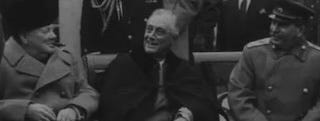
The picture of Churchill, Roosevelt, and Stalin has become a kind of icon for me. Three men shaping the conduct of an awful war and the post war future of Europe.
Churchill was an Anglican, skeptical, comfortable in the tradition though not a regular participant; he viewed religion as an important force in maintaining stability and the fabric of society. He exhibited a complex form of humility. He had an immense belief in his own abilities and balanced that with the understanding that he was a servant of history and the British people. Throughout his life, he showed a capacity to learn from mistakes and remain open-minded. His war cabinet included people with opposing viewpoints.
Roosevelt was a lifelong practicing Episcopalian (Anglican) who sought to apply Christian ethics to social problems. He changed from being an arrogant, privileged politician to a compassionate leader after contracting polio when he was 39. Frances Perkins described it was a new “humility of spirit”
Stalin as a young person was preparing to become an Orthodox priest, he abandoned faith for Marxism and was an atheist. Real humility wasn’t in him. He fostered a cult of personality with propaganda describing him as "Great" and "Beloved." He’d publicly downplayed his own importance, feigning humility as a political strategy. Stalin was noted to have despised Dostoevsky's focus on humility, viewing it as a weak trait
Those three were the-people-in-the-room. They came together twice. First, in the 1943 Tehran Conference to plan wartime strategy and then in the 1945 Yalta Conference to discuss the post-war reorganization of Europe.
The result was millions of deaths in the war and a post-war Europe, half free and half living under tyranny. The result also has been 80 years of relative peace. For perspective it may help to recall that the First World War ended in 1918 and the Second began in 1939. Twenty-one years of relative peace.
Responsible decision making doesn’t bring utopian solutions, often not even penultimate solutions. You get the best thing possible given the circumstances at the time as seen by the-people-in-the-room and as they apply their differing ethics frameworks. It involves the process of listening, reflecting, and acting. Each element engaged with differing degrees of skill and integrity.
But the Lord said to Samuel, “Do not look on his appearance or on the height of his stature, because I have rejected him; for the Lord does not see as mortals see; they look on the outward appearance, but the Lord looks on the heart.” (From 1 Samuel 16, in today’s Morning Prayer)
This abides,
Brother Robert, OA
The pictures are General Ulysses S. Grant during the Civil War and Dwight D Eisenhower during the Second World War. They are in the public domain.
RELATED