
Reflection
O God, you call us to freedom and responsibility

..our belief is that the whole process only makes sense in so far as, in the risk and the struggle of creation, that which is is advancing into fuller potentialities of being and is overcoming the forces that tend toward dissolution; and that continually a richer and more fully diversified unity is built up. ...The end, we have seen reason to believe, would be a commonwealth of free, responsible beings united in love; and this great end is possible only if finite existents are preserved in some kind of individual identity. Here again, we may emphasize that the highest love is not the drive toward union, but rather letting-be. - John Macquarrie
Reflection, the essential form of personal devotions
Reflection is a form of personal devotion that helps us make intentional connections between our formation in common prayer and responsible action in the world. Brother Scott Benhase points to it in Done and Left Undone, “We should step back, gain perspective, listen to others, and spend time in solitude so we can think reflectively and prayerfully. Such reflective time is a necessary precursor to right actions.”
In themselves personal devotions are practices that are a connection between our daily life and the presence of God. There are many forms of personal devotions - centering prayer, grace at meals, Lectio Divina, the Jesus Prayer and so on. Brother Lowell’s Practicing Prayer: A Handbook is a useful overview of some practices. Sometimes the “new Christian” will find themselves overwhelmed with all the possibilities. There’s a need to narrow things down. It's useful to think about seeking an alignment between a particular practice and the person’s life circumstances, temperament, gifts, and need to be stretched.
Personal devotions have their most efficiency and effectiveness as an element of the Prayer Book Pattern - Sunday Eucharist, Daily Office, Personal devotions. Our worship tradition as Episcopalians is based on that three-part structure. Michael Ramsey, the one-hundredth Archbishop of Canterbury, referred to it as the “Benedictine triangle.” Martin Thornton called it the “Catholic Threefold Rule of Prayer.” (MORE)
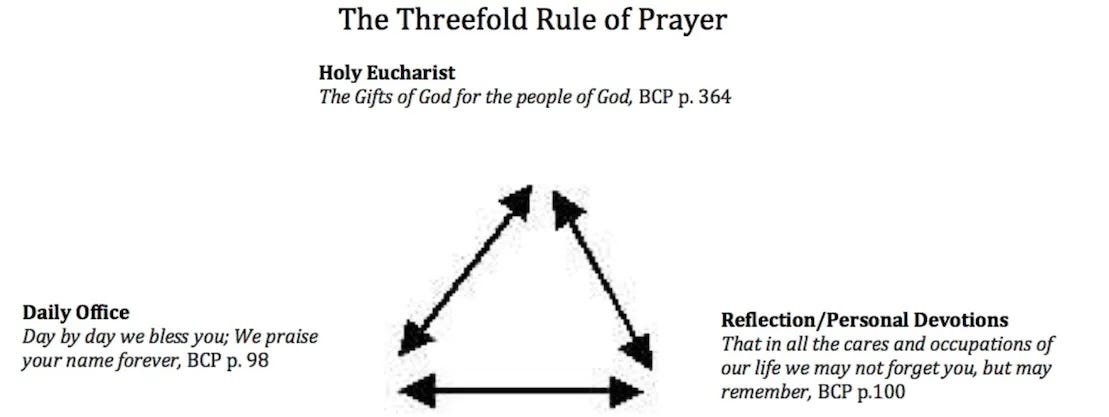
In Sister Michelle’s “Afterword” for Practicing Prayer: A Handbook she writes, “Participating in Morning or Evening Prayer, whether we do it with others or by ourselves, is always corporate prayer. The Office is the prayer of the Church, not our personal prayer. And, along with the Eucharist, provides the grounding central to an Anglican system of spiritual practice.”
What I’m suggesting in this article, is that reflection is the essential personal devotion for the faithful Christian in our time. It is thinking in the presence of God for the sake of the world. It is the connection between our participation in the church’s common prayer and our ethical and moral action in daily life. It moves us beyond abstract principles to concrete responsibility.
Bonhoeffer - concrete responsibility
The ultimate question for a responsible man to ask is not how he is to extricate himself heroically from the affair, but how the coming generation is to live. It is only from this question, with its responsibility toward history, that fruitful solutions can come, even if for the time being they are very humiliating. In short, it is much easier to see a thing through from the point of abstract principle than from that of concrete responsibility. The rising generation will always instinctively discern which of these we make a basis for our actions, for it is their own future that is at stake. - Letters and Papers from Prison Dietrich Bonhoeffer
Having returned from the safety of teaching at a seminary in the United States to the world of Nazi Germany, Bonhoeffer ended up struggling with a moral dilemma. His decision to participate in the plot to kill Hitler was a decision for concrete responsibility over abstract principle. His own ethical purity sacrificed for what he saw as the future of his nation.
He wrote, “Who stands his ground? Only the man whose ultimate criterion is not in his reason, his principles, his conscience, his freedom, or his virtue, but who is ready to sacrifice all these things, when he is called to obedient and responsible action in faith and exclusive allegiance to God. The responsible man seeks to make his whole life a response to the question and call of God. …Only now, are we Germans beginning to discover the meaning of free responsibility. It depends upon a God who demands bold action as the free response of faith, and who promises forgiveness and consolation to the man who becomes a sinner in the process.”
His commitment was to a God “who demands bold action … and who promises forgiveness.” This wasn’t an intellectual resolution to his moral dilemma but an act of obedience and humility. (From Abstract principle and concrete responsibility
“Bonhoeffer” was a seminary course. I received a B. Bonhoeffer was also the man who was imprisoned before I was born and executed at the Flossenbürg concentration camp when I would have been 6 months old. By the time I was in seminary, that was twenty-some years in the past. The issue of Christian behavior under the Nazis remained a lively interest in the churches. Bonhoeffer’s life and writings helped raise all the issues faced by the Christian who sought to intentionally and faithfully navigate freedom and responsibility. Sister Michelle and I recently had a conversation in which we wondered who might be comparable figures since then.
Bonhoeffer integrated his prayer life with ethical action by giving himself to traditional spiritual disciplines such as daily prayer, scripture reading, and meditation. Those practices served as a foundation for Christian resistance and public action. He believed prayer created empathy, solidarity with the oppressed, and the courage necessary to oppose evil and engage in concrete, responsible actions for justice. Without such grounding resistance to evil would be impossible to sustain. He understood that intercessory prayer brings us into solidarity with others and the responsibility to act on behalf of those suffering. We can hear an echo of that in Martin Thornton’s, “Moral action only flows from doctrinal truth by grace and faith, that is through prayer.” (From Pastoral Theology: A Reorientation)
Bonhoeffer, in obedience to his conscience, chose concrete responsibility over abstract principle. For most of us, most of the time, we might seek more harmony between the two. Though finally we are all called to some form of concrete responsibility.
Those of us in the Order of the Ascension have taken a Promise, “To seek the presence of Jesus Christ in the people, things and circumstances of life through stability, obedience and conversion of life.” For us, it is in our daily life among people, things and the circumstances of life that we are called to seek and shape tangible and specific pathways. Concrete responsibility flowing from our reflection and in obedience to our conscience. Each Christian will have some method or system to engage that task.
Reflection, in the presence of God, in the service of freedom and responsibility
But Mary treasured up all these things and pondered them in her heart (Luke 2:19).
I experienced reflection as a gift. At times it's like a spontaneous eruption of awareness and conscience. And other times, it is a disciplined turning of my mind to the task. It is always a gift of the Holy Spirit. It rises from our worship. K. E. Kirk saw it this way, “The first practical question for Christian ethics is.. How is disinterestedness, unselfishness, to be attained? Once grant that moralism, or formalism, cannot bring the soul nearer to it, and there remains only one way— the way of worship. Worship lifts the soul out of its preoccupation with itself and its activities and centres its aspirations entirely on God…” (From The Vision of God) Martin Thornton points in the same direction, “Christian action is not action of which Jesus approves but action that he performs through his incorporated, and therefore prayerful, disciples.”
Our process of reflection may involve a general openness to the virtue of counsel or guidance. An openness to the Holy Spirit, an “energy not our own.” It is related to developing a capacity for listening and an inner silence. Or on occasion, it may involve some more discipline method such as Macquarrie’s compassionate thinking and/or responsible thinking. Processes of going out of oneself: of standing alongside the other person in thought and especially intercessory prayer and acting in a responsible manner toward others by taking into account their needs and claims. (See more in Compassionate thinking in the presence of God)
Reflect, analyze, explore, chew over, muse — or like Mary ponder in your heart. A process done in the presence of God, in the context of the church’s liturgies, in inner silence, and issuing in concrete responsible action.
He withdrew again to the mountain by himself - John 6:15
This abides,
Brother Robert, OA