
Compassionate and responsible thinking
In the presence of God

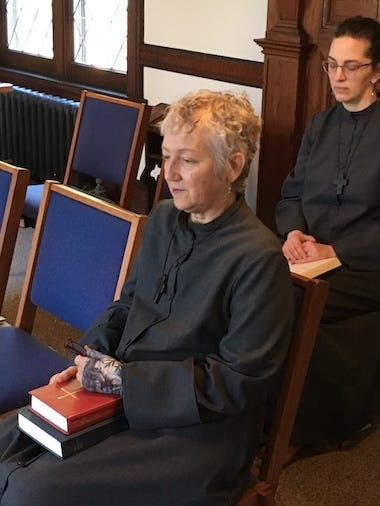
Any authentic priesthood must derive from an inner core of silence, a life hid with Christ in God … Only those who are at home with silence and darkness will be able to survive in, and minister to, the perplexity and confusion of the modern world. Let us seek that dark silence out of which an authentic ministry and a renewed theology can grow and flourish. — Kenneth Leech, during the 1988 retreat of the Order of the Ascension
The most important form of personal devotions is reflection, a form of prayer that helps us gain perspective on our lives and integrate our faith and action.
“Our world is not one that encourages reflection. As the collect has it, ‘We are placed among things which are passing away,’ and we are ‘to hold fast to those that shall endure.’ Sorting one from the other is the work of reflection. It’s all too easy to lose yourself. There’s not some uncomplicated way to maintain a sense of perspective and moral vision. It calls for thought and discipline. … Practical, responsible action is the outcome of a process: There’s a bit of self-awareness, attentiveness to what’s happening around us, there’s a capacity to understand what is important, there’s an adequate ability to manage our own emotions and behavior, there’s a life grounded in Mass and Office, and there’s an openness to listening to voices other than our own. Of course, where that leads me may differ from where it leads you. I am to obey my informed conscience and you are to obey yours.”
We each need to find methods of reflection that are helpful given our temperament and circumstances. “How do you reflect now? What are the ways in your life that you become centered and still? How do you gain a sense of perspective and proportion? In my own life this has frequently been connected to long walks in the city, a drink with a friend, and spiritual reading, often done with some work-related purpose in mind. I know that each practice may not offer anything useful for others. We each have our own way. A member of my parish wrote about how it happens for her while hiking in the mountains. ‘Seeing the Earth from a different perspective and in such beauty shakes up stagnant thoughts that are weighing me down, brings up new observations, and opens my mind and soul to new ways.’ We each need to find what works for us. In time, and with guidance, we can expand on how we reflect.” (In Your Holy Spirit: Shaping the Parish Through Spiritual Practice. chapter 4)
Prayer as compassionate and responsible thinking
The truth is that prayer and action, the inward and the outward, are bound together in such a close reciprocity that it makes no sense to ask, which comes first. They are in constant interaction. Prayer interprets the world, and the world interprets prayer. - John Macquarrie, Paths in Spirituality
John Macquarrie wrote about prayer as compassionate and responsible thinking in “Prayer is Thinking” in the The Furrow in 1970 and in chapter 3 “Prayer as Thinking” in Paths of Spirituality in 1972 and a 2nd edition in 2012 (Also see here and here).
In a 1972 New York Times book review Nash Burger wrote, “Prayer, he holds, is not an emergency signal we send out to God in a difficult situation; it is a fundamental style of thinking, passionate and compassionate, common both to those of religious faith and of none. ‘To pray is to think in such a way that we dwell with reality, and faith's name for reality is God.’”
Macquarrie writes about prayer as a kind of thinking. It's not the same kind of thinking that we use when we are trying to solve our problems.. Prayer is not “a kind of magic shortcut to some desired end.” He writes about prayer’s place in the changing world of the 1960s and 70s, a picture that may be even more apparent today.
But there is a strange contradiction in the human condition today. Alongside the increasing specialization and fragmentation of the functional man, we find at work factors that keep drawing us into an ever increasing closeness and independence. …Because of our fragmentation and individualism, we are ill prepared to meet the new demands that we should be able to see things as a whole, and that we should be able to experience more wholeness in our own lives.
Look at the whole board
Macquarrie was concerned that the structures of modern society made it more and more difficult to see the big picture, the connection among people, circumstances, and events. He sought a capacity to see a wholeness. Thirty years latter - in the wake of the 2000 election, the 9/11 attack on the Twin Towers and Pentagon, and the Iraq War - many would watch a TV show, the West Wing, and see Martin Sheen as President "Jed" Bartlet, playing simultaneous chess games with Toby Ziegler and Sam Seaborn. The games with Toby and Sam symbolize the strategic maneuvering of the president with Bartlet advising them to "look at the whole board". The show presented a world where public servants were portrayed as dedicated, intelligent, and motivated by a genuine desire to do good for the country. For many on the nation’s political center-left it was certainly a form of escapism and a coping mechanism. It was also an expression of their desire to know a greater wholeness, to “look at the whole board”.
During that period the Order of the Ascension had its annual retreat at Camp McDowell in Alabama. It was our practice then, and it still is now, to go out on Wednesday night to a local restaurant. We went to a local ribs grill and on the way had a discussion about how we were accustomed to watching the West Wing every Wednesday night. So when we arrived at the restaurant, we saw they had a small television in the waiting area and we asked the owner if we could stay after dinner in that area and watch the show. He was a friendly conservative southerner, who was glad to accommodate us. He allowed us to use the room, even after the restaurant had closed. As it turned out, the show wasn’t on that night. On the ride back, we speculated whether it was some kind of Alabama conservative censorship. When one of us called home we were relieved to find out that the series was simply skipping a week everywhere in the country.
The phenomenon is repeating itself now during the Donald Trump presidency for similar reasons. I’ve read comments in the New York Times and Washington Post of secular and humanistic citizens once again watching the West Wing, now on Netflix. Sister Michelle and I are midway through the fifth season. It’s a longing for wholeness. A desire for compassionate and responsible thinking.
I believe that very human need was what motivated many during Ronald Reagan’s era with its “morning again in America" and a “shining city on a hill” linking Winthrop's sermon to their hopes and emphasizing a shared purpose and divine blessing in our national identity. Maybe it was the same longing in Barack Obama’s emphasis on hope — "The Audacity of Hope” with its "belief in things not seen" and the "bedrock of this nation"; also in the chants of “Yes we can” and his speech “A More Perfect Union" highlighted his belief in continuous national progress and unity despite a complex racial history.
Macquarrie writes about the overlap between the non-religious, though spiritual humanists, who engage in compassionate and responsible thinking. “Prayer is a fundamental style of thinking, passionate and compassionate, responsible and thankful, that is deeply rooted in our humanity, and that manifests itself not only among believers, but also among serious-minded people who do not profess any religious faith.”
Ways of thinking-in-the-presence-of-God
Macquarrie offers several ways of looking at prayer as thinking-in-the-presence-of-God.
Passionate thinking: A way that is open to “feeling the world as well as knowing it”… “it catches the vision of what might be and longs for realization.”
Compassionate thinking: Involves going out of oneself, standing alongside the other person, and sharing their feelings and aspirations, which leads to increased sympathy and community building. “For the Christian, compassionate thinking takes the form of intercessory prayer, a compassionate confrontation with the needs of the other in the presence of God. Intercessory prayer includes compassionate thinking, but it is something more and implies the belief that in such prayer, not only the person who prays is sensitized and stimulated to action, but that the power of God himself is somehow related to the situation, which is the concern of the prayer.” (See more in Compassionate thinking in the presence of God)
Responsible thinking: Entails responsibility to the neighbor and taking into account their needs and claims. Prayer is our responsible thinking in the presence of God.” Again, this is a form of prayer that takes us out of ourselves.
A commonwealth of free, responsible beings united in love
I met Father Macquarrie once in the early 1970s. I was attending a weekday Morning Prayer at one of the small chapels of Oxford University. There were maybe five of us. Father Macquarrie was the officiate that day. At the time I was a new priest in the Diocese of Pennsylvania. So, when he came to the intercessions and said that in the Anglican Cycle of Prayer “today we pray for the Diocese of Pennsylvania” – I had one of those is-this-coincidence-or-divine mystery moments. A moment of wholeness, of seeing the whole board.
In seminary I read his Principles of Christian Theology. Macquarrie was an existentialist theologian. In the book he made a case that existentialism was a rediscovery of themes already present in the New Testament, such as authentic versus inauthentic living. His writing serves as a systematic framework that incorporates existentialist concepts like angst, freedom, and personal responsibility into a traditional Anglican theological structure.
It’s still on my shelf. And of course, I read his section on Cosmic and Individual Destinies.” I still return to the underlined parts.
Strictly speaking, we cannot know the ultimate destiny of the world or of man … and as St. John declares that “it does not yet appear what we shall be” .. [That said he goes on to add] … The end would be all things gathered up in God, all things, brough to the fulfillment of their potentialities, for being, at one among themselves, and at one with Being from which they have come in for which they are destined. … Rather, our belief is that the whole process only makes sense, in so far as, in the risk and struggle of creation, that which “is” is advancing in the fuller potentialities of being, and is overcoming the forces that tend toward dissolution; and that continually a richer and more fully diversified, unity is being built up … the end, we have seen reason to believe, would be a commonwealth of free, responsible beings, united in love. . … [He goes on to note one of my favorite lines from the BCP] … it is perhaps significant that the prayers for the departed seem to have moved from the thought of the attainment of static rest to that of increasing perfection. In 1549 the Book of Common Prayer besought for them “thy mercy and everlasting peace”; the current, American edition, prays for their “continual growth in thy love and service.” [Still seen in Rite One Prayers of the People]
The Prayer Book Pattern
Our reflection in the presence of God sits within a basket of common prayer. Our engagement of compassionate and responsible thinking gains its effectiveness and efficiency because it rests upon the common prayer of the church.
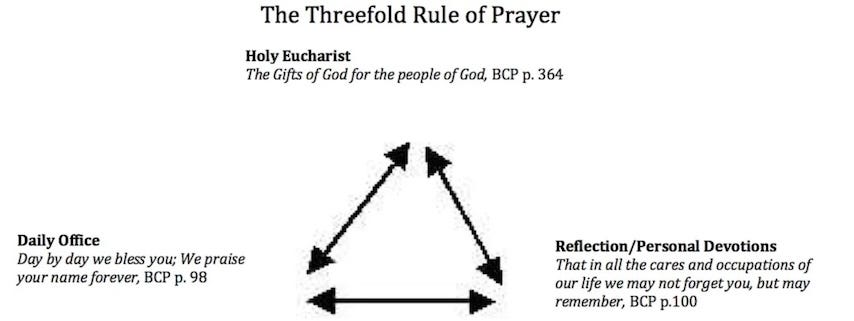
Eucharist - Daily Office - Reflection is my way of understanding the Prayer Book Pattern. Michael Ramsey, the one-hundredth Archbishop of Canterbury, referred to it as the “Benedictine triangle.” Martin Thornton called it the “Catholic Threefold Rule of Prayer.”
Weekly and daily
It’s a pattern common to the major religious traditions. There is a weekly communal form of prayer and a daily form. The Jewish Sabbath, or Shabbat, is a weekly 25-hour period of rest and spiritual rejuvenation, observed from sundown on Friday to nightfall on Saturday. Judaism's daily prayers, called Tefillot, are divided into three main services: Shacharit (morning), Mincha (afternoon), and Ma'ariv (evening). Islam has five daily prayers (Salat) at specific times: Fajr (dawn), Dhuhr (midday), Asr (afternoon), Maghrib (sunset), and Isha (night), facing Mecca, and an obligatory weekly congregational prayer on Fridays (Jumu'ah).
Episcopalians have the Sunday Eucharist and the daily office which may be said by oneself or as a community gathered in a chapel or on the internet. Giving ourselves to these common prayers of the church shapes our hearts and minds. It educates our conscience. It offers wisdom and depth to our reflection. Our life in community, our reflection, and our service are nurtured from the soil of Office and Eucharist. The daily connection with Scripture and common prayer and the weekly receiving of Body and Blood orient us to the ways of eternity and feed us for “real life.” We become familiar with the ways of heaven. We chose to place ourselves in the pathways of grace. A PDF placing compassionate and responsible reflection within the Prayer Book Pattern.
The many forms of personal devotions
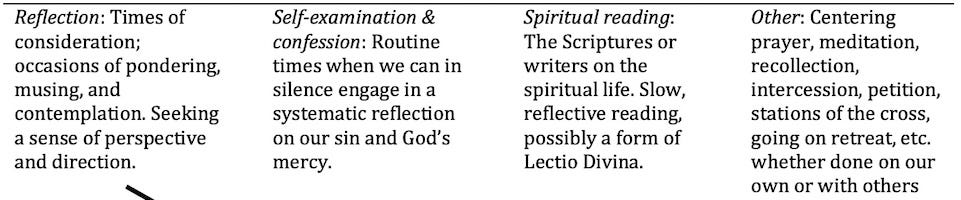
It's easy to understand what is meant by Eucharist and Daily Office. The Book of Common Prayer offers them as acts of worship, and most of the book is devoted to them. The Prayer Book Pattern assumes personal devotions. Fair enough; they are “personal” not “common” forms of prayer. An individual's temperament, gifts, and circumstances will come in to play as people take on some of the practices of personal devotions. And for many this brings on confusion. In the church's life, we will come across dozens, even hundreds of ways of expressing personal devotions. The parish may have a weekly centering prayer group or an intercession group. There will be opportunities for a quiet day or retreat at a convent. During Lent some churches offer stations of the cross. When I was growing up, my Roman Catholic friends would cross themselves when they heard the siren of an emergency vehicle. Even now when I hear a siren the words of the Kyrie Eleison come to mind. Many offer prayer before and after meals. I have found myself sorting the possibilities into four categories: reflection, self examination, spiritual reading and other.
Pray that He who made the universe may sustain the universe
My understanding is that as Martin Thornton aged he came to the conclusion the reflection was the essential form of personal devotion. I've had the same experience. Our reflection is an effort to see more clearly - in compassion and responsibility, to see the whole board - in the face of chaos and destruction.
Charles Williams had an understanding of evil that he expressed in his novel, War in Heaven). “Dimly he knew at what end the attack aimed; some disintegrating force was being loosed at the vessel—not conquest, but destruction, was the purpose, and chaos the eventual hope.”
In War in Heaven, there’s a scene in which malign forces are attacking the Graal. There’s an Archdeacon, Duke and Kenneth in the room. Here’s some of what happens—
Archdeacon: “It may be that God is dissolving it but I think there is devilry. Make yourselves paths for the Will of God. …Pray …”
Duke: “Against what shall we pray?”
Archdeacon: “Against nothing. Pray that He who made the universe may sustain the universe.”
A profound silence followed, out of the heart of which there arose presently a common consciousness of effort. … They existed knit together, as it were, in a living tower built up around the sacred vessel, and through all the stones of the tower it’s common life flowed. Yet to all their apprehensions, and especially to the priest’s, which was the most vivid and least distracted, this life received and resisted an impact from without. The tower was indeed a tower of defense, though it offered no aggression, and resisted whatever there was to be resisted merely by its own immovable calm.
In the priest: Dimly he knew at what end the attack aimed; some disintegrating force was being loosed at the vessel—not conquest, but destruction, was the purpose, and chaos the eventual hope. … Silence and knowledge were communicated to him as if from an invisible celebrant; he held the Cup no longer as a priest, but as if he set his hands on that which was itself at once the Mystery and the Master of the Mystery.
May the priestly people of God pray—That He who made the universe may sustain the universe. (From More – “Chaos the eventual hope.”
In our reflection, in the presence of God, we are called to work out our salvation.
Our vocation is not simply to be, but to work together with God in the creation of our own life, our own identity, our own destiny-to work out our own identity in God, which the Bible calls ‘working out salvation “ is a labor which requires sacrifice and anguish, risk and many tears. Thomas Merton (From the Rule of the Order of the Ascension)
This abides,
Brother Robert, OA
RELATED
Abstract principle and concrete responsibility
Worship lifts the soul out of its preoccupation with itself
Christian Faith and Public Disorder