

Then Zedekiah said to Jeremiah, “Do not let anyone else know of this conversation, or you will die. If the officials should hear that I have spoken with you, and they should come and say to you, ‘Just tell us what you said to the king; do not conceal it from us, or we will put you to death. What did the king say to you?’ then you shall say to them, ‘I was presenting my plea to the king not to send me back to the house of Jonathan to die there.’” All the officials did come to Jeremiah and questioned him; and he answered them in the very words the king had commanded. So they stopped questioning him, for the conversation had not been overheard. And Jeremiah remained in the court of the guard until the day that Jerusalem was taken. (From Jeremiah 38 in Today’s Morning Prayer
Do we too often focus our emotions and thinking on matters that are important but about which we have little influence while at the same time we don’t use the influence we have in the institutions we are part of.
So we get a lot of virtue signaling, moralizing and grand talk about being on the right-side-of-history or God being on our side in some argument about which we know relatively little.
How the sausage is made [1]
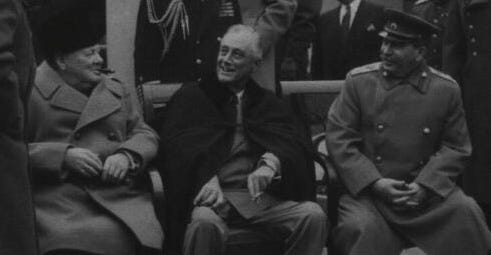
We often don’t want to know the messy details behind a finished product. It may be unsettling to hear what takes place to produce a Middle East peace deal, the termination of a choir director, or a meeting to carve up the world. The words spoken and the deals made by the-people-in-the-room may make us a bit queasy. The uncomfortable fact is that if there was 100% transparency about everything very little would get done.
The people in the room
I will bless the Lord who gives me counsel; *
my heart teaches me, night after night. (Ps 16:7)
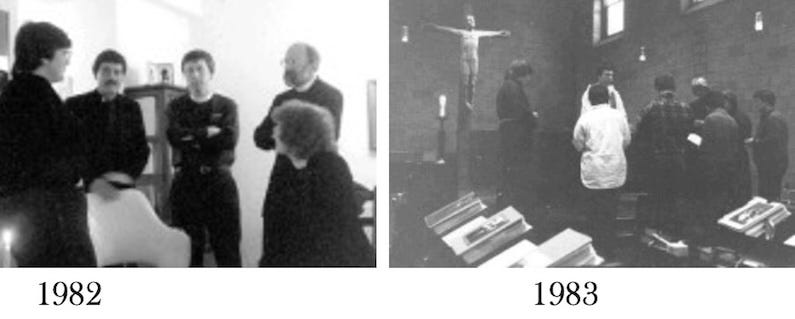
You may have noticed that I have frequently used the phrase the-people-in-the-room. On September 29 the people in a room at the White House included Donald Trump, Ophir Falk, Jared Kushner, Ron Dermer, and Benjamin Netanyahu. There would be a whole series of meetings with different people in the rooms all over the world to get the Arab nations and the Palestinian Authority (PA) on board. The 1982-83 meetings that led to the creation of the Order of the Ascension had different sets of people in the room, with some overlap, in meetings at General Theological Seminary and Saint Helen's convent. We even have pictures.
There are also pictures in this morning’s “Behind Closed Doors: How the Deal With Hamas Was Born” by Amit Segel an Israeli journalist. Dan Senor’s podcast “How the Deal Came Together, and What Comes Next?” (YouTube) looks at the same process leading to the release of the hostages and the broad 20 point peace plan. ( or just listen to the podcast)
In the end it is the social ethics of the-people-in-the-room that make the deals. Pope John XXIII had this in mind when in Pacem in Terris 1963) he noted that it is not enough for Christians “to be illumined by the heavenly light of faith and to be fired with enthusiasm for a cause; they must involve themselves in the work of [every] institution, and strive to influence them effectively from within.” The effective use of our influence in the sphere in which we find ourselves was the task. “Every day provides a more important, a more fitting enterprise to which they must turn their hands—industry, trade unions, professional organizations, insurance, cultural institutions, the law, politics, medical and recreational facilities, and other such activities.”
What rooms are you in?
God grant me the serenity to accept the things I cannot change, the courage to change the things I can, and the wisdom to know the difference.
Sister Michelle frequently uses the Circles of Influence model as she helps people become more faithful and realistic about the use of their power.
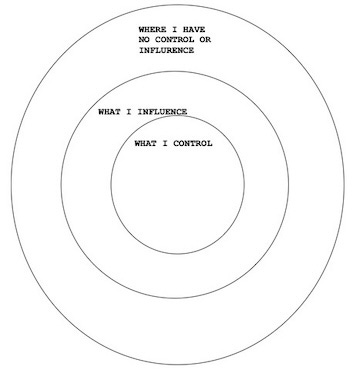
From AI “The circle of influence model is a tool that helps individuals distinguish between what they can control, what they can influence, and what they cannot control, to reduce stress and improve productivity by focusing energy on actionable items. By consciously shifting focus from the outer “circle of concern” (e.g., the economy, politics, other people’s actions) to the inner “circle of influence” (e.g., one’s attitude, relationships, planning), people can become more proactive and effective.”
“One way to use the model is as a contemplative act. Have the diagram in front of you. Begin with silence, maybe after you have said Morning Prayer. Then in brainstorm fashion place the groups, people and circumstances, and issues of your life in one of the circles. Don’t overthink it—you can revise it later. It’s your attempt to honestly lay out the limits of your influence. Your reflection might consider: How do you behave when faced with those limits? Anger, resentment, contentment, efforts to expand your influence? In the places where you have influence, how do you exercise that power? How do you cope with the human inability to do so ‘perfectly?’ How well do you exercise patience, courage, persistence, and humility? The names of people and groups on your worksheet are now an intercession list, people you will note in prayer, some to be carried on your heart before God.” (From Finding God in All Things: Contemplation, Intercession, and Intervention)
Parish community meetings
One way to expand participation, to be more inclusive about who are the people in the room, is to have parish community meetings.
“The parish community needs regular meetings over the course of the year. At times the whole parish, at other times a congregation within the parish. That will depend on the issues to be engaged. These meetings need to make use of the methods known to facilitate dialogue and listening. Having three or four such meetings each year provides the opportunity to engage more people in the significant questions of the community’s life. It is important that these not turn into “town meetings” with their image of a contentious and argumentative spirit. It’s also important that they not undercut the responsibility of the rector and vestry for decisions they have to make. They are a chance for leaders to test things with the community and for the community to hear its own voice. The effect of such regular gatherings is usually increased trust and commitment.” (From In Your Holy Spirit: Shaping the Parish Through Spiritual Practice)
Sister Michelle has been designing and facilitating such community meetings at St Clement Parish, Seattle in what we call “St. Clement’s 2040”. These gatherings have done overall assessments of the parish’s life and work, worked through the difficult process of terminating a staff member, prioritizing property improvements, and explored how we wanted to express the parish’s sanctifying presence in the community.
And so, to him who sits upon the throne, *
and to Christ the Lamb,
Be worship and praise, dominion and splendor, *
for ever and for evermore. Dignus es
This abides,
Brother Robert, OA
The Feast of Ignatius, Bishop of Antioch, and Martyr, c. 115
[1] The sausage quote is often attributed to “Otto von Bismarck“ or “John Godfrey Saxe. I used one by Mark Twain
Related
Benedictine Balance and Social Ethics: In you we live and move and have our being
God graciously accepts that service: Even when we are quite wrong
Loving critics: Pity the leader caught between unloving critics and uncritical lovers