
Survey feedback
Survey - Shared analysis - Energy

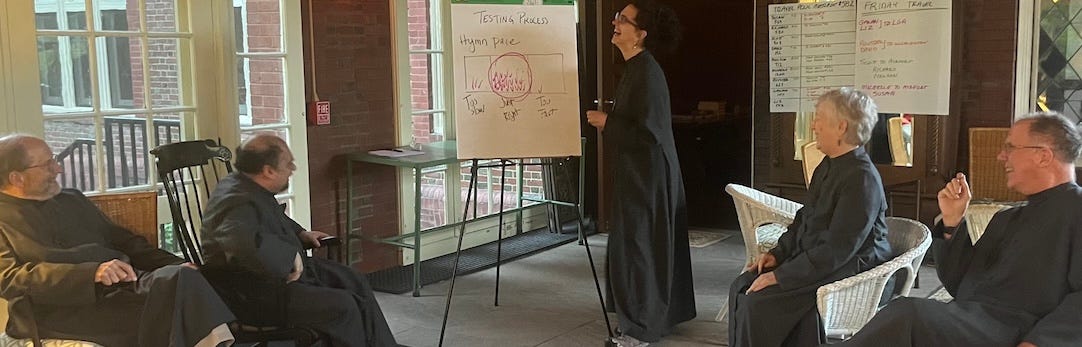
“Listen”—that is how the Rule opens. It establishes the key to what St. Benedict is asking: that we listen to one another and listen to God. “Listen with the ear of the heart,” he will say later. This is total listening, not the cerebral listening of the head but coming from the heart which is the true innermost self. It means to listen with sensitivity and openness. - Seeking God: The Way of St. Benedict
Survey-feedback is an organization development intervention in which those taking the survey see and interact with the results. It’s been one of the most effective interventions in the field, in part because the method is likely to increase energy around needed change. Its a way into expressing and hearing the collective voice of the parish. It creates a connection between the gathering and analysis of information and the ability of the parish community to act.
For the purposes of this article, I'm going to oversimplify the process by highlighting three elements: survey, shared analysis, energy. I hope you'll be inspired to find out more about the process. Sister Michelle and I cover it in Chapter 2 of Finding God in All Things.
Survey
This can range from a simple testing process at a coffee hour taking 30 minutes to a several page survey that requires 20 minutes to fill out, time to collate the results, and a shared analysis process of some hours. Here are examples of such a survey - Team Assessment, Vestry Self Assessment, Purposes of the Parish Assessment, Assessing using the Benedictine Promise, Incorporation Process Assessment. You can find dozens more in Shaping the Parish Resources.
These wider assessments are generally more useful if they are based on a mental model, for example, The Benedictine Promise or the stages of incorporation into a parish.
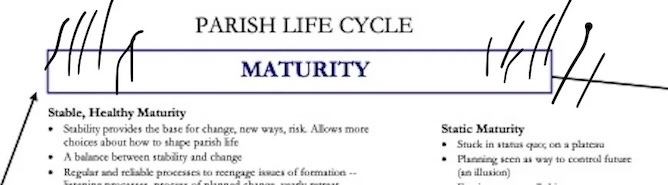
There are other forms of doing a “survey” that don’t fit how we usually think about a “survey.” For example, a few days ago I posted about The Parish Life Cycle. We used the survey-feedback process but instead of responding to a series of questions we used a diagram of the model, and the parishioners put a mark to indicate where they thought the parish was in the cycle.
Shared analysis
This happens in a feedback session in which those who completed the survey, explore the results of that survey. We come together and a facilitator asks a question like, “What do you make of the results?” You may form small groups to discuss the question. Or you may go around the room, giving each person a brief time to offer their thoughts.
This is a very different way of approaching the survey results from the kind of survey that may be offered to the entire parish with the results going to the rector and the vestry. Or worse, yet, a meeting in which a consultant from the organization that created the survey arrives to tell the parish what it means.
Noting the picture using the parish life cycle (above), the vestry was split between the older African-American members - “we are stable and healthy” - and the younger Caribbean members - “we are static” - they were able to honestly consider their different views. Each group shared their experience and hopes for the parish.
Energy
There is energy in a group as they move through the process. At the very beginning, some people will be anxious about a survey others excited. Some resistive and maybe some wanting to use it to beat a drum.
In a Mid-Atlantic church we used an early version of “Key Factors” with a vestry. They rated themselves this way -
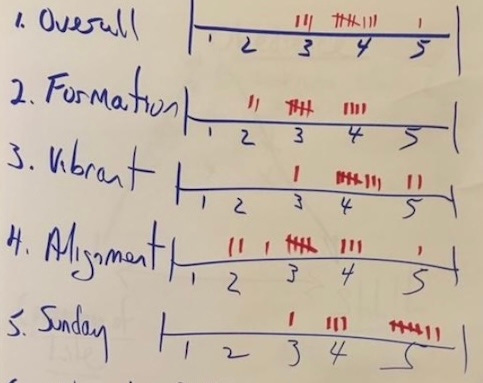
Overall satisfaction, being vibrant, and the Sunday morning experience were relatively high. It was a positive affirmation of their parish experience. They are also the elements that most parishioners are invested in. Formation and alignment, however, were weaker. Alignment [1] issues don't stir large numbers of people in most parishes unless a crisis develops around a lack of alignment. And while clergy may see formation as terribly important, that sense of importance is mostly seen by lay leaders who happen to be apostolic or progressing in faith and practice. So frequently, even if they give low ratings, there will not be much negative energy exhibited. However, in this particular case, the alignment issue did have the elements of a crisis. There were fears of losing an important part of the parish’s life. For a brief time, there were tears by some and emotional paralysis from others.
Five years later the vestry used “Key Factors” again and gave the parish these ratings.
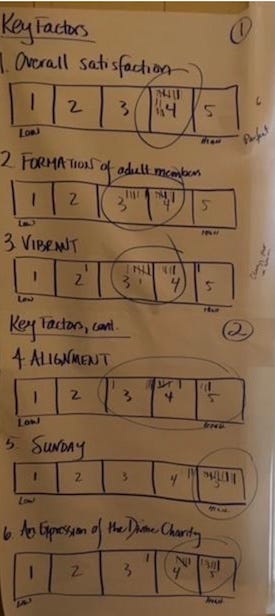
The ratings were generally higher. The one that stood out though was “alignment.” It took a few years. They had dealt with the crisis and the rating was both higher and clustered. They had learned ways of understanding alignment, were on the same page, and now had a common language
Next steps - first steps?
Well, maybe. Maybe working out next steps or first steps will be the right thing to do at the end of the meeting. It’s also possible that pushing forward in that moment would backfire. The leader needs to read the room. What are people ready for? What do they need to do before we close the meeting?
A follow up meeting? Let the rector or the rector and the vestry decide what to do with what we have learned?
A method that can be very useful is to have the group, maybe in sub groups, brainstorm and prioritize, possible follow-up actions based on the work they have done together. The prioritized list of items might then be passed on to a vestry or parish staff or an appropriate committee to act upon. That often brings a sense of completion, allowing people to see the time they have spent as productive.
For truly I tell you, if you have faith the size of a mustard seed, you will say to this mountain, ‘Move from here to there,’ and it will move; and nothing will be impossible for you. -From Matthew 17
This abides,
Brother Robert, OA
Also see Survey feedback and internal commitment
[1] Alignment: The elements of parish life are mostly in alignment: income-expenses, the energy, and funds to carry out the vision we have; liturgical space or number of services to match the number of attendees, and so on. Here’s an updated version of “Key Factors”
The Feast of Hilda, Abbess of Whitby, 680
A list of all our articles on: Social Ethics Spiritual Life Parish Development