

Then Jesus told his disciples, “If any want to become my followers, let them deny themselves and take up their cross and follow me. For those who want to save their life will lose it, and those who lose their life for my sake will find it. For what will it profit them if they gain the whole world but forfeit their life? Or what will they give in return for their life? - From Matthew 16
The Parish Life Cycle can be an excellent tool for generating needed conversations. The first parish I became Vicar of in South Philadelphia was disintegrating. My appointment and a high degree of collaboration with the bishop’s office amounted to an external intervention that over several years turned things around.
I asked, “who's on the vestry?” No one could remember. I said how about we try this, “We have a series of one hour meetings before Mass for several Sundays. We do an assessment of where we are is a perish, and we look at our possibilities for the future. Anyone who participates in all the meetings we declare to be our vestry.” Everyone agreed. It was the beginning of setting a new direction, not quite yet a vision. In the coming years new people would be attracted, the three purposes of a parish church engaged, and our resources enlarged. The starting point was to acknowledge that we were falling apart.
The Parish Life Cycle
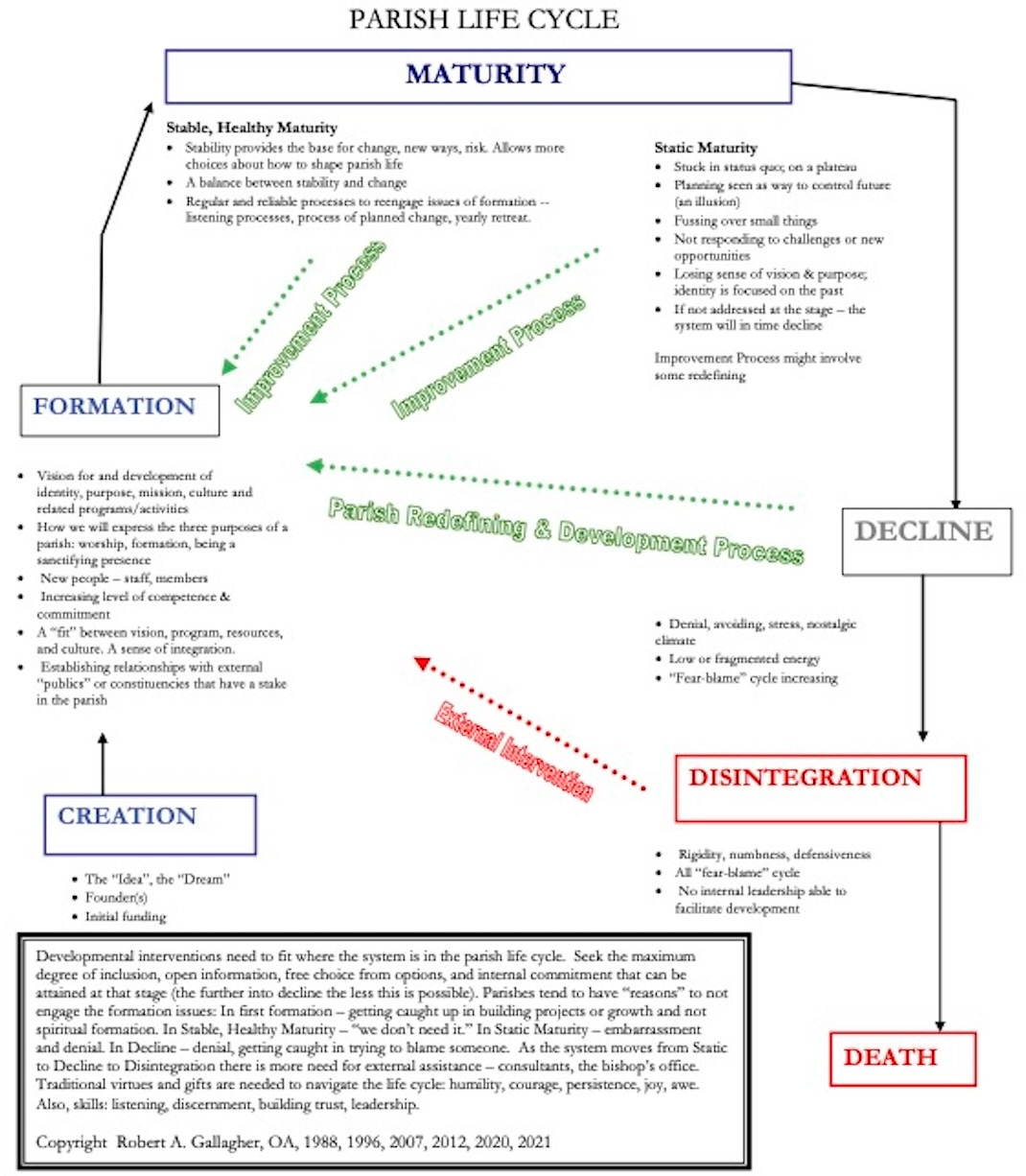
Here’s a PDF of the Parish Life Cycle You may find it useful to have it in front of you as we go along. A full explanation of the Cycle is available in An Energy Not Its Own: Three cycles of parish life and the purposes of the parish church.
Three stories
Here are three stories of parishes that used the Parish Life Cycle to begin a necessary conversation. Sister Michelle and I were the consultants on the first. The other two were consultations I did before beginning to work with Michelle.
A college town
The rector was close to retirement. He invited about 35 members for a weekend gathering to assess the state of the church. We used a number of different approaches over the weekend. One of them was the Parish Life Cycle. After an explanation of the cycle, people were invited to come forward and place a mark on where they believed the parish was in the cycle.
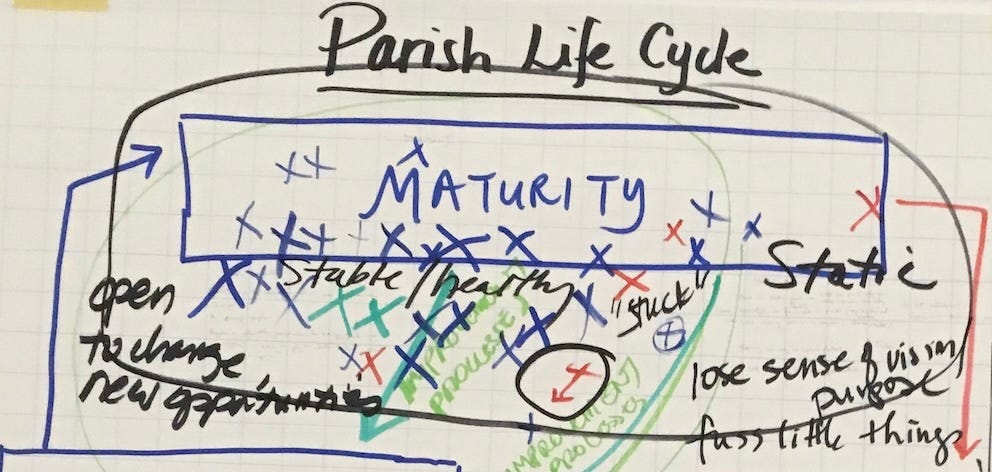
There were no marks on Decline. People were generally reassured. This was pretty much what most assumed to be true. But being able to express themselves in this form told them that what they assumed was true. Overwhelmingly, they thought of the place as being mature in a stable and healthy manner. A few thought the parish was becoming Static. We used several other assessments of parish life and ministry. Strengths and weaknesses were identified. I believe that the process helped the rector to decide he could go ahead with his retirement and parish leaders to believe that they were in good shape for moving into a transition.
Should we merge?
It was a historically Black parish. Alive in the spirit and over time had become institutionally weak. Members were getting older, the building was in disrepair, there simply wasn't enough money. They agreed to have a meeting with me and a diocese staff person. The bishop thought that they needed to consider merger with a nearby parish that was in better condition, but was also struggling. I was clear with the Bishop and his staff that I was not going to push them toward a merger, but to help them to explore their options.
I prepared for the meeting, expecting to use two tools to help them look at their situation: the Parish Life Cycle and Parish Options. I was ready to jump into the work. But as we gathered, I found myself thinking, “I need to back up.” The room was full of pain. At least that was my sense of it. So I decided to begin with a question - “What is it like being part of this parish now?” One by one we went around the table. Each spoke of their love for the church and their life together. There was an acknowledgment of the institutional problems. There were tears.
For just a moment, I want to step aside from what happened that morning. What went into my decision to have them go around the table and share how they were feeling? One factor was that every parish I had been the Vicar or priest-in-charge of had a significant percentage of Black parishioners, ranging from 50 to 90%. Over the years they had taught me about how things often worked out between them and the larger diocese. In some ways, what they helped me see wasn't much different from the story of many small and vulnerable parishes in any diocese. A fear that someone in the position of power in the diocese would take steps to close them, to destroy their life together, and tell them they had to die in order to rise again. The parish I now attend is an Anglo-Catholic parish with an African-American heritage. And a significant part of that heritage rises from how a liberal Bishop and Diocese closed a Black church some years ago. They did it because it was the liberal thing to do at the time. Parishes should be integrated they believed. It was the conventional wisdom of that time. Diocesan officials apparently weren't very interested in the views of the Black parishioners. It also doesn't seem to have occurred to them that they might close a few of the all white parishes in the cause of integration. The assumption seemed to be that it was up to these Black parishioners to make integration occur.
So let's return to that day with the vestry sitting around a table. I asked if it would be acceptable to move onto an assessment of the state of the parish. They agreed. I introduced the Parish Life Cycle. They moved up to the easel and put their marks on where they believed their congregation was at this point.
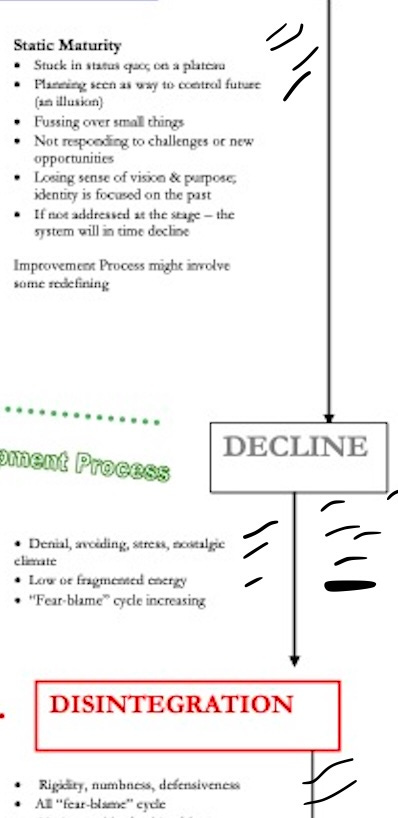
There were no marks in “stable and healthy maturity.” None on the green lines of improvement and development. People shared what they made of their assessment. Their honest assessment of where they were as a community opened the way to exploring their options for the future. They talked about their attempts to attract new members. That option didn't seem to hold much appeal anymore. A couple of people wondered about closing. Overtime they began to focus on the merger possibility. They selected five other parishes to consider, three of which were predominantly African-American. That set them on a two year journey in which they focused their attention on the church geographically closest to them. The talks were difficult. There was a significant body of people in the somewhat stronger parish who did not want to consider a merger. However, the clergy and wardens in both parishes persisted and the merger did take place.
A parish church faces three basic demands of the spiritual life -- “the need not to run away, the need to be open to change, the need to listen. They are based on a commitment which is both total and continuing. And yet the paradox is that they bring freedom, true freedom.” Esther de Waal
We need to talk
This was a consultation that was part of a diocesan discussion about creating an urban team ministry involving several churches. This particular parish was seen as a relatively stable community that had a number of long-term African-American members who in recent years have been joined by a significant number of younger parishioners from the Caribbean. We used the Parish. Life Cycle to kick off a conversation about the state of their parish and how that might fit into a possible team arrangement. After an introduction, they came forward and placed their mark on the news sprint.

The older African-American members of vestry were shocked by the split result. The shock deepened as everyone realized that it was the older African-American members who saw the parish as stable and healthy, and the younger Caribbean members who saw it as static. There were no marks on the green lines indicating that an improvement process was underway.
As they talked with one another it became clear that there were unspoken issues that came as a surprise to the African American members. They wanted to know why things hadn’t been brought up before. They were bewildered. The younger Caribbean members said that had been out of respect and not wanting to disrupt the harmony of St. Mark’s. Those comments about respect and harmony seemed to relieve the tension in the room. What could have moved into a defensive and argumentative meeting instead became the beginning of a conversation. In the same session they assessed the parish using Likes/Concerns/Wishes Process. The items were prioritized with the African American members using green markers and the Caribbean members using red markers. That allowed them to identify areas that required further discussion as well as help to focus on concerns and wishes they agreed needed to be addressed soon. - From An Energy Not Its Own: Three cycles of parish life and the purposes of the parish church.
The story of every parish should be a love story. ...One possible definition for a parish is that it is God’s way of meeting the problems of the unloved. This meeting between God and the unloved, the unwanted, takes place in the preaching of the Word, in the Sacraments, in the social life of the parish made possible by the climate of acceptance which is engendered by those who have been baptized and confirmed in the Catholic faith. One of the main tasks of the parish priest is to train the militant core of his parishioners in such a way that they understand as fully as possible the true nature of a Christian parish. -- Kilmer Myers
This abides,
Brother Robert, OA
A list of all our articles on: Social Ethics Spiritual Life Parish Development
Our work on antisemitism: Antisemitism - yes, again The menorah and the swastika The light shines in the darkness Amsterdam What do you see? Antisemitism is a shape-shifting virus There was the illusion that America was different, that it couldn’t happen here Antisemitism is like crabgrass A time for humility Anti-Zionism & Antisemitism. Jewish manipulation
RELATED