
Survey feedback and internal commitment
Intervention theory - Trust development theory


The cult of the twenty-nine-year-old martyr grew very rapidly, and his remains were eventually enshrined in a Benedictine monastery in Bedericesworth—now called Bury St. Edmunds. Over the centuries, Edmund’s shrine became a traditional place of pilgrimage for England’s kings, who came to pray at the grave of a man who remained steadfast in the Christian faith and loyal to the integrity of the English people. - BSG article on St. Edmund
Why has survey-feedback been seen as possibly the most effective Organization Development intervention?
In the Order of the Ascension we’re learning how to make use of survey-feedback. It's a choppy process. I was delighted to receive Brother Lowell's example of a process he led with a Theology on Tap group. They were struggling with the location. Lowell wrote, “The biggest organization issue for us is the venue. We need a place that serves beer and drinks as well as a meal. The room must be pretty quiet because several of us are fairly deaf. Background noise and ambient music needs to be low. We also need enough room for up to 30 people to sit where we can see and hear each other.” He had them fill out a survey. The results indicated the preference for staying at the current location. The group discussed the results. By the time they were done, those who were dissatisfied with the current location, appeared to have accepted “the results graciously.” People appreciated the opportunity to explore the issue.
Brother Lowell's process was exactly right if you look at the three elements I wrote about yesterday in Survey Feedback - Survey, Shared analysis, Energy. The issue being explored wasn’t as large as whether to merge or how to cope with tensions between older and younger members. But there was a result that had something in common with those other examples. The outcome of the process resulted in an adequate level of internal commitment on the part of the people involved. (For more on survey-feedback see Chapter 2 of Finding God in All Things.)
Merciful God, who gave grace and fortitude to Edmund to die nobly for your Name: Bestow on us your servants the shield of faith, with which we can withstand the assaults of our ancient enemy; through Jesus Christ our Redeemer, who lives and reigns with you and the Holy Spirit, one God, now and for ever. Amen.
Internal Commitment
One of the wonderful things about survey-feedback, when done well, is that it is a process that offers all the elements necessary to build the foundation for internal commitment. So let’s look at two theories.
Intervention theory
My take on Chris Argyris’s Intervention Theory goes this way — internal commitment is built upon valid and useful information and free choice.
We want as much internal commitment as is possible in a given situation. The markers are things like: When a decision is made we have a high degree of ownership and feeling of responsibility, people are acting under the influence of internal decision rather than external forces, it’s more likely to hold over time and under stress, and it’s open to re-examination.
The assumption is that to the extent we get “valid and useful information” that offers us a base for “free choice.” And to the extent that we have free choice, we are likely to get a higher degree of internal commitment from people. In Brother Lowell’s case validity was seen in the involvement of most of the “regulars” and the open discussion of the survey results. It was useful in a very pragmatic manner and that it settled a dispute. The group’s open discussion is essential. It allowed the group to hear and experience its common voice and mind. All too frequently is cut across that possibility by talking with members only one on one rather than bringing them together for a group discussion - “What do we make of the survey results?”
The measures we look for in “free choice” involve the group’s assessment of the likelihood of success if we move in that direction, that there was a real choice to be made, and that it was a decision that people experienced as voluntary, not coming from habit. The regulars that were dissatisfied with the current location, proposed another pub. The process allowed their preference to be considered. Those wanting another pub accepted “the results graciously.”
[More - A video on the theory. Also, Intervention Theory is covered in Chapter 6 of Finding God in All Things.]
Trust Development Theory
Trust development theory seeks to maximize a state of internal commitment, collaboration, and self‐management. It sees a base of inclusion and acceptance that enables open information in the system which in turn facilitates shared direction.
It’s like a set of building blocks
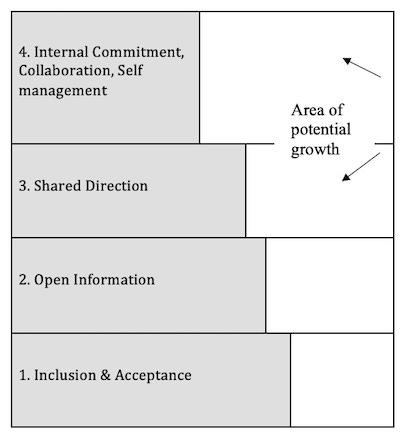
It also assumes that if the base is not adequate, things fall apart.
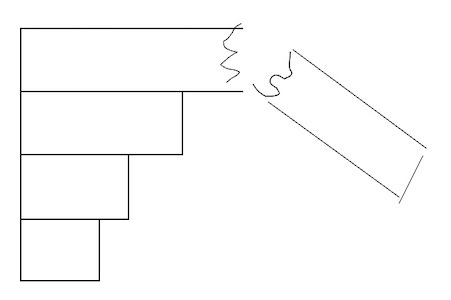
Looking again at Brother Lowell's search for the perfect pub, we see something like this. Among the regulars, there was a level of acceptance and inclusion that allowed them to engage a survey and a conversation to make sense of the survey results. What emerged out of that was a shared direction. All things considered they would stay with the pub they had been using.
In my career, I have facilitated a few survey-feedback situations in which individuals attempted to stop a group from completing a survey or completing the shared analysis steps. The difficulty would arise when just one or two people had difficulty managing their emotions or were so invested in having their way that they disrupted the group’s process. I remember using the go-around-the-circle method in which each person gets a brief period of time to share their views on the survey results. We'd be going from one person to the next, listening to each quietly and respectfully. And we'd hit a person who instead of taking under one minute would make a 15 minute speech. On one occasion, it was because the person saw himself as an expert that everyone needed to listen to. In another, it was clearly an attempt to derail the process as the person flew into a rage about how the church should not be having this conversation at all. In those two cases, my approach was simply to wait out the disruptors. Fortunately, each one did not get support from others in the group and they finally stopped talking. In another case, a person stormed out of the room and probably found themselves surprised that no one followed them and asked them to return. In all those situations, the group was able to complete its discussion and analysis and indicate a direction that they had some level of internal commitment to.[Trust development theory is addressed in Chapter 5 of Finding God in All Thingsand Chapter 5 of In Your Holy Spirit: Shaping the Parish Though Spiritual Practice]
That we may be bound together by your Holy Spirit in the communion of the Blessed Virgin Mary, Edmund, and all your saints, entrusting one another and all our life to Christ,
We entreat you, O Lord.
This abides,
Brother Robert, OA
Also see Survey-Feedback for an overview of the process.
The Feast of Edmund, King of East Anglia, 870