
The checks of conscience
"Our constitution was made only for a moral and religious people." -John Adams

I’ve started to watch Ken Burns “The American Revolution.” [1] In the first episode there is this quote by Mercy Otis Warren.
The study of the human character opens at once a beautiful and a deformed picture of the soul . We there find a noble principle implanted in the nature of man. But when the checks of conscience are thrown aside, or the moral sense weakened, humanity is obscured.
She saw a link between personal morality and the nation’s well-being.
Warren had a lifelong, tumultuous friendship with John Adams. They wrote frequently about the nature of the new republic. That fact reminded me of a John Adams quote from an address to the Massachusetts Militia on October 11, 1798,
Our constitution was made only for a moral and religious people. It is wholly inadequate to the government of any other.
It was a rather common belief among the Founders that American freedom relied not simply on the law but on the virtue of its citizens. They thought that the existence of a virtuous citizenry, guided by religious principles, was necessary for self-governance. Without such virtue they feared that either chaos or despotism would destroy the new republic.
Chaos or despotism
In our present situation many of us wonder if chaos and despotism are acting hand-in-hand because of the President’s temperament. Is he bringing the two into a partnership? However the earlier assumption of the Founders can also be seen today. It may be pushed to the background because of the space taken by the president while still remaining the more significant dynamic facing the nation in the coming decades.
Within Ken Burns’ work, there is illustration after illustration that acknowledges the threat to a democratic people coming either from an autocratic individual or the passion of a mob.
The Founders didn’t want the government to establish a state religion while also holding that religious values and morality were for a successful republic. Religious freedom could allow a variety of faiths to shape public morality while avoiding religious coercion.
George Washington [2] called religion and morality "indispensable supports" for political prosperity.
Of all the dispositions and habits which lead to political prosperity, religion and morality are indispensable supports. In vain would that man claim the tribute of patriotism who should labor to subvert these great pillars of human happiness, these firmest props of the duties of men and citizens. The mere politician, equally with the pious man, ought to respect and to cherish them. A volume could not trace all their connections with private and public felicity. Let it simply be asked where is the security for property, for reputation, for life, if the sense of religious obligation desert the oaths, which are the instruments of investigation in courts of justice? And let us with caution indulge the supposition that morality can be maintained without religion. Whatever may be conceded to the influence of refined education on minds of peculiar structure, reason and experience both forbid us to expect that national morality can prevail in exclusion of religious principle. (The Farewell Address)
We can see Washington’s stance within his letter to the Jewish congregation in Newport, Rhode Island.
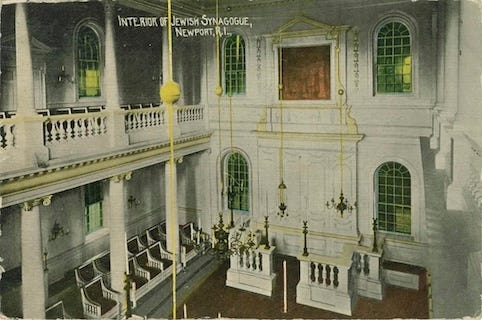
May the Children of the Stock of Abraham, who dwell in this land, continue to merit and enjoy the good will of the other Inhabitants; while every one shall sit in safety under his own vine and figtree, and there shall be none to make him afraid. May the father of all mercies scatter light and not darkness in our paths, and make us all in our several vocations useful here, and in his own due time and way everlastingly happy.
Thomas Jefferson wanted a strong and healthy public morality rising from voluntary faith and free from government control. That was what would enable both personal belief and national well-being. John Adams wrote, "Our constitution was made only for a moral and religious people. It is wholly inadequate to the government of any other.” James Madison both advocated religious freedom and believed that "sufficient virtue among men for self-government" was needed, or "nothing less than the chains of despotism can restrain them. The Founders wanted a society in which religion nurtured morality and virtue while the government remained neutral by not imposing a single religious creed.
The role of the church today
I’d stress two things. First, the formation of the conscience of our parishioners through worship, prayer and education. Second, a public stance of support for human dignity and to be critical of chaos and despotism whether from authoritarian individuals and government agencies or from mobs in the streets and on-line.
Underhill affirmed the way of adoration and awe issuing in faithful service. Bishop Phil of Olympia called us to attend to our inner life.
Contemplation and prayer feed the spring of water in our inner life, which then feeds the stream of action and how we engage the world. This contemplative work must be done first and with regularity if our actions are to remain pure and in the way of Jesus. If we disregard tending to our souls, we run the risk of making our desires to do good solely about ourselves and potentially being harmful, both to ourselves and to others.
We are also in need of compassionate and responsible thinking in the presence of God if we are to live in humility and avoid the seduction of the mob. St. Anthony the Abbot offers wisdom, “Do not trust in your own righteousness.”
Related - Worship lifts the soul out of its preoccupation with itself, Forming our conscience, Compassionate and responsible thinking, and Pragmatism, ideology and faith
Consider joining us for Social Ethics Lent 2026. Four Saturday mornings on Zoom, no fee.
Do not fret yourself because of evildoers; *
do not be jealous of those who do wrong.
For they shall soon wither like the grass, * and like the green grass fade away.
Put your trust in the Lord and do good; *
dwell in the land and feed on its riches.
Take delight in the Lord, *
and he shall give you your heart’s desire.
Commit your way to the Lord and put your trust in him, *
and he will bring it to pass.
He will make your righteousness as clear as the light *
and your just dealing as the noonday.
Be still before the Lord *
and wait patiently for him. (Psalm 37: 1 - 7, Morning Prayer today)
This abides,
Brother Robert, OA
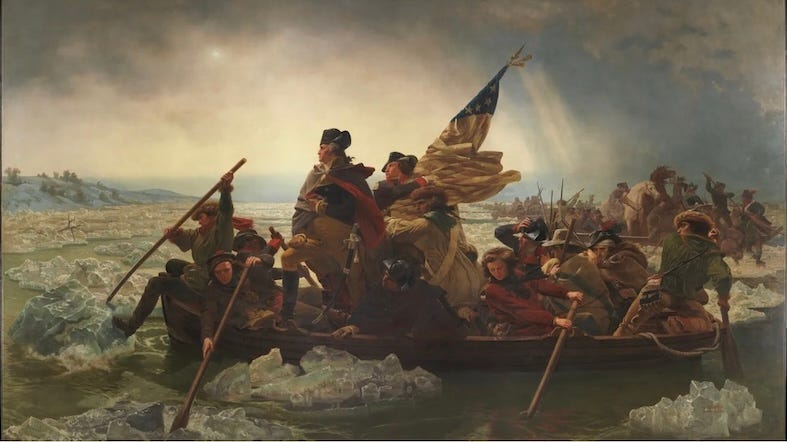
Emanuel Leutze’s painting of Washington Crossing the Delaware is in the public domaine and can be seen at The MET. I selected it because of my own history. I grew up in Philadelphia, camped with the Boy Scouts at Valley Forge, spend considerable time in the historic district of Philadelphia, and have been at Washington Crossing Park. For a few years I was the Vicar of St. Michael’s, Trenton founded in 1703, walked the area when the Battle of Trenton was fought and visited the Barracks. The painting is of George Washington crossing the Delaware on Christmas night 1776 to make a surprise attack on Hessian troops in Trenton, New Jersey.
[1] Daniel Fienberg’s review of The American Revolution in The Hollywood Reporter caught my attention because he said the series was "patriotic, pragmatic and familiar." He saw Burns work as capturing the era's revolutionary spirit and the enduring, complex American experiment. In our time we need to consider the nation’s story with respect, consider its complexity, and take a stance of pragmatic understanding.
[2] George and Martha Washington routinely attended services at Christ Church, Philadelphia while he was President. They rented pew, #5658. Washington’s funeral was held at Christ Church in 1799.