
Measuring interventions
Broader & deeper


Parish leaders are called to do two things in their role. Monitor the parish’s life and work and take initiative to improve things. We assess and we intervene.
This morning in the Shaping the Parish program, when we gather at 9:00 am (Pacific, I’m going to offer a brief presentation on measuring interventions. Here’s my line of thought.
In our work this cycle, beginning in October, the participants have explored several interventions such as: gathering the community for counsel, grounding the parish in the threefold rule of prayer, instituting certain group methods and norms (such as listening processes and increasing face-to face in person communication), ways of reflecting as a personal devotion. In the upcoming module we’ll add to that list as we look at several parish development interventions raging from a weekend conference in a large stable parish to seven years as vicar in a small struggling inner-city parish. We’ll learn about the impact of what role we are in and specific processes such as survey-feedback. Today the group is going to discuss action plans, another type of intervention.
You can measure interventions in themselves. You could ask people if they learned anything. Or were they satisfied with what we did together. And that is worth doing. In the group’s second session back in October, they assessed their sense of inclusion by holding up between one and five fingers. Most said four or five. That told us that our particular methods of preparing participants for the program were adequate. We also knew that doing an assessment is an intervention in the system. Assessments change the system. In that last assessment we hoped many people would gain a sense of the satisfaction level of the whole group as well as see a quick data gathering method.
Broader and deeper
Parish leaders also need ways to measure, to assess, interventions in a manner that is broader and deeper than looking at the intervention itself. We also want to beware of measuring short-term rather than long-term. When you as a leader move onto some new parish, will your few years in this parish have made it a healthier more faithful community?
In Shaping the Parish we expose participants to dozens of models that can serve that broader and deeper purpose. I’ll mention just three today.
A Benedictine measure
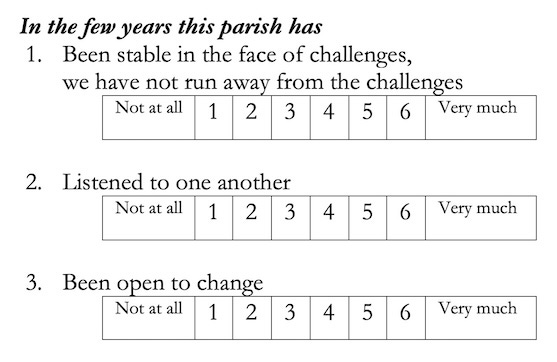
A parish church faces three basic demands of the spiritual life -- “the need not to run away, the need to be open to change, the need to listen. They are based on a commitment which is both total and continuing. And yet the paradox is that they bring freedom, true freedom.” Esther de Waal Esther deWaal
A parish systems measure
You might use the Shape of the Parish model and ask if the parish’s apostolic center has been stable and provided an adequate degree of grounding for the whole parish.
A healthy process measure
You could use Intervention Theory to assess the overall process of your developmental efforts. For example ask, in the last few years have we increased the sense of internal commitment regarding our life and direction among members? Have we experienced a sense of free choice in making decisions? Have we generally had the information we needed to make reasonable decisions?
This abides,
Brother Robert, OA