
Just War?
"Peace be with you. As the Father has sent me, so I send you." When he had said this, he breathed on them and said to them, "Receive the Holy Spirit. If you forgive the sins of any, they are forgiven

It depends upon a God who demands bold action as the free response of faith, and who promises forgiveness and consolation to the man who becomes a sinner in the process.
Random thoughts this morning. Is a just war possible in today's world? Are large segments of the church dwelling in a fantasy of avoidance about the use of force? Is such avoidance necessary given the costs of any war? While the church continues to speak of the Just War Theory has it actually shifted it to a pacifist position?
To honestly engage the questions we have to set aside — President Donald Trump. Yes, I know it’s hard to do. For some impossible. I have come to believe in the reality of Trump Derangement Syndrome (TDS). The usual definition has come from supporters of Donald Trump who see it as an irrational, and obsessive hatred of Trump by his critics that causes them to lose objectivity. I believe it is more accurate to apply TDS to both those supporters and critics of Trump who are unable to engage any issue without working it through the lens of their feelings about the President. The loss of objectivity cuts both ways. So, I am asking you, for just a few minutes, to place your feelings about Trump - pro or con - on the shelf. Try to engage the issue of war and peace by exploring the larger picture. It may help to consider a number of wars in our history that took place prior to the election of Donald Trump.
Peace should be the object of your desire; war should be waged only as a necessity…in order that peace may be obtained - St. Augustine
The Just War Theory
“‘For a war to be just,’ writes Thomas Aquinas, ‘three things are necessary’: sovereign authority, just cause, and right intention (Aquanis). As James Turner Johnson observed, these correspond directly to what Augustine identified as the three goods of the political community: order, justice, and peace. The just war tradition is set within a larger moral framework of good politics oriented to a just and peaceful order in which ‘the use of armed force is a necessary tool to be used by responsible political authority to protect that just and peaceful order in a world in which serious threats are not only possible but actual’ (Johnson, 2005a).” The Church has frequently called on the faithful, “to study, understand and utilize the Just War tradition developed over the centuries” This is from an article on the church’s website. “Over the millennia, the just war tradition has developed two sets of criteria, one pertaining to the justice of going to war in the first place (jus ad bellum) and the other regarding justice in the course of fighting (jus in bello). The Episcopal Church has embraced these criteria as means to understanding and applying the tradition.” Here’s the whole article. (From “Ethical clarity in a time of war”)
Popes and Presidents
In today’s Dispatch Faith Dan Hugger begins his piece with U.S. President George H.W. Bush and Pope St. John Paul II. It’s 1990-91. Iraqi had invaded Kuwait. The UN had condemned the invasion and called on Iraq to withdraw. The United States had developed a coalition of 42 nations to enforce the United Nations’ resolution. The Pope sent the President a letter in January 1991 -
In recent days, voicing the thoughts and concerns of millions of people, I have stressed the tragic consequences which a war in that area could have. I wish now to restate my firm belief that war is not likely to bring an adequate solution to international problems and that, even though an unjust situation might be momentarily met, the consequences that would possibly derive from war would be devastating and tragic. We cannot pretend that the use of arms, and especially of today’s highly sophisticated weaponry, would not give rise, in addition to suffering and destruction, to new and perhaps worse injustices.
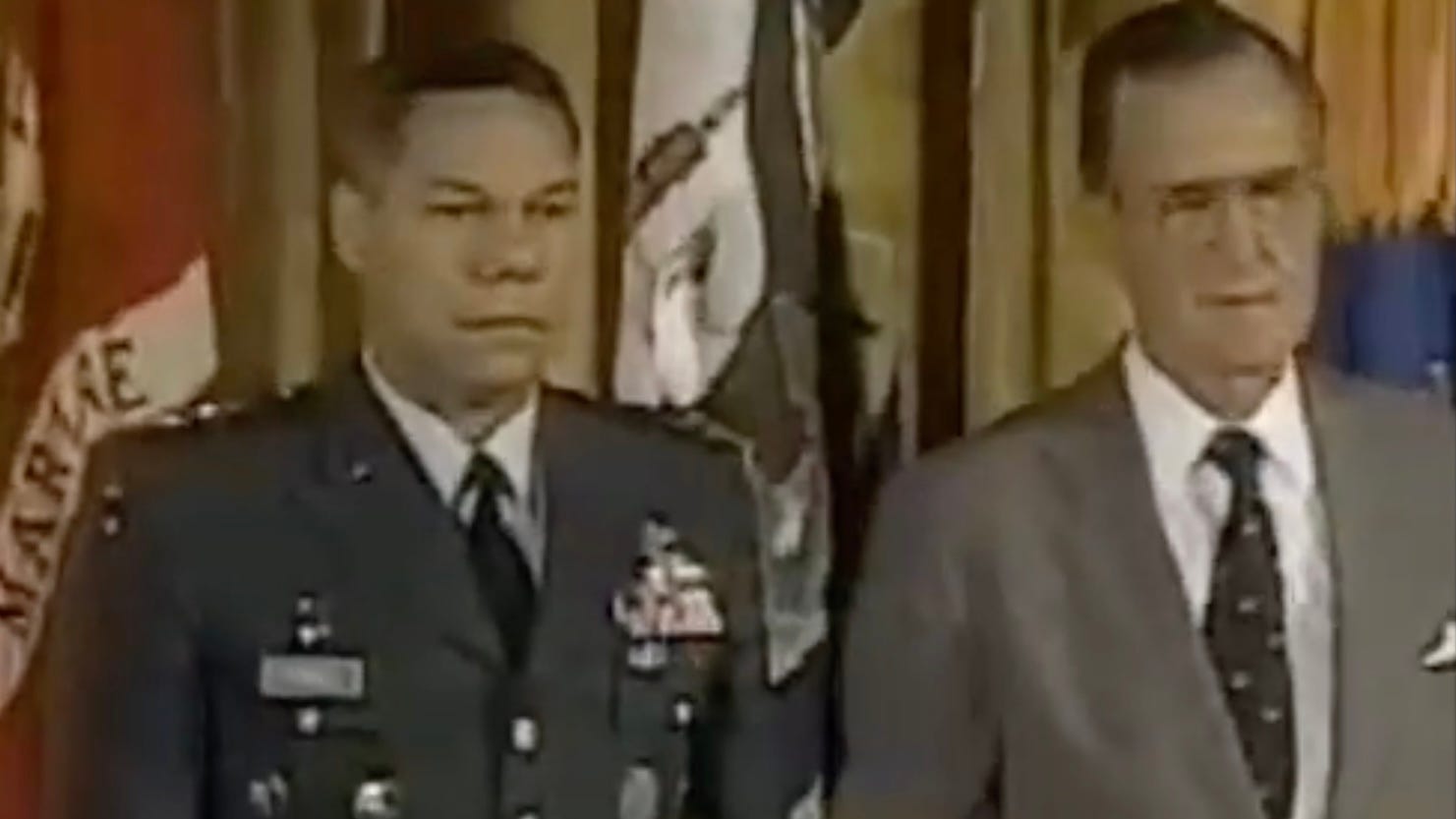
Operation Desert Storm began with an air campaign on January 17, 1991 with the ground offensive commencing on February 24. That lead to to an Iraqi retreat by February 28. Bush halted the war after just 100 hours of ground fighting. Iraqi forces were out of Kuwait. Bush wanted to maintain the UN-sanctioned coalition, avoid a messy occupation, and prevent regional instability. It’s worth noting that two of the primary people-in-the-room making decisions about the war were both Episcopalians. President Bush and General Colin Powell then the Chairman of the Joint Chiefs of Staff.
The Pope believed that
war is not likely to bring an adequate solution to international problems
that even though an unjust situation might be momentarily met, the consequences that would possibly derive from war would be devastating and tragic.
The Pope appeared to be talking about all war not simply this war. In recent decades, there's been a good bit of discussion about how the Roman Catholic Church, along with many other denominations, appear to have move away from the Just War Theory to a stance emphasizing nonviolent peacemaking over active military engagement. Many church leaders have adopted a stance that modern warfare is almost always immoral and disproportionate, making it difficult to satisfy the traditional, strict conditions of “just war”.
Does an absolute refusal of war conflict with the obligation to protect those who cannot defend themselves against an aggressor? Advocates of the anti-war stance argue that the church's role is not to serve the interests of statecraft but to act as a moral agent, arguing that modern conflict often leads to unmerited suffering, which is fundamentally unjust.
Where does that stance leave us?
Dan Hugger writes, “Success against such obvious aggression makes Pope St. John Paul II’s failed intervention appear naive if not outright foolish, for the world’s standard of peace is the absence of war, the restoration of rightful sovereignty, and compliance with resolutions. Pope Leo XIV’s recent condemnations of war and exhortations toward peace in the midst of the Iran war strike many Americans, both inside and outside the Catholic Church, as similarly suspect. His pointed words seem to some political, to others naive, a ridiculous figure crying “Peace, peace; when there is no peace.” (Jeremiah 6:14)”
Hugger ends up in the place I find myself. It is the social ethics of the people-in-the-room that have concrete responsibility. “Whether or not the current blessedly paused and hopefully concluded Iran war meets these “just war” criteria is the subject of ongoing debate. It is a question that cannot be settled by philosophy and theology alone and requires knowledge and expertise in at least the disciplines of economics, military science, and diplomacy. It is a prudential judgment that can only be made by “those who have responsibility for the common good,” who ultimately include all members of society, but particularly political authorities, civic leaders, and social institutions at all levels of society. It is not a checklist but a guide to discernment, which each one of us has a duty to participate in as stewards of the common good.”
Church leaders: to act as a moral agent and/or to guide pragmatic discernment among the baptized who are the people-in-the-room
Social ethics can be done in abstraction. You know, that’s the process in which we are dealing with ideas not events, it isn’t very concrete. It’s a very useful way to deal with ideas. But when the necessity to act is upon a person or a nation, things get very concrete.
I doubt there is ever been a fully just war. Many talk about the Second World War as a just war. Yet, that war was the deadliest conflict in history, with total deaths estimated between 70 and 85 million, including 15–20 million military personnel and over 40-50 million civilians. Allied actions that contradicted Just War Theory (specifically jus in bello—conduct in war) primarily involved widespread civilian targeting.
Even as we try for perfection there is always sin and human limitation. We preachers cry, “Peace, peace; when there is no peace.”
I have frequently felt that the statements coming from Popes and Presiding Bishops amount to an abandonment of the baptized. I understand the desire to urge peace. To insist that diplomatic efforts be made. But if that is all we do. If that is where we leave the discussion. Have we abandoned the baptized?
Do we have no guidance to offer that is pragmatic?
I have a great appreciation for the life of Dietrich Bonhoeffer
In “Letters and Papers from Prison” Dietrich Bonhoeffer wrote, “The ultimate question for a responsible man to ask is not how he is to extricate himself heroically from the affair, but how the coming generation is to live. It is only from this question, with its responsibility toward history, that fruitful solutions can come, even if for the time being they are very humiliating. In short, it is much easier to see a thing through from the point of abstract principle than from that of concrete responsibility. The rising generation will always instinctively discern which of these we make a basis for our actions, for it is their own future that is at stake.”
Having returned from the safety of teaching at a seminary in the United States to the world of Nazi Germany, Bonhoeffer ended up struggling with a moral dilemma. He’s decision to participate in the plot to kill Hitler was a decision for concrete responsibility over abstract principle. His own ethical purity sacrificed for what he saw as the future of his nation.
He wrote, “Who stands his ground? Only the man whose ultimate criterion is not in his reason, his principles, his conscience, his freedom, or his virtue, but who is ready to sacrifice all these things, when he is called to obedient and responsible action in faith and exclusive allegiance to God. The responsible man seeks to make his whole life a response to the question and call of God. …Only now, are we Germans beginning to discover the meaning of free responsibility. It depends upon a God who demands bold action as the free response of faith, and who promises forgiveness and consolation to the man who becomes a sinner in the process.”
This abides,
Brother Robert, OA
Picture is in the Public Domain
Today is the anniversary of the death of President Franklin Delano Roosevelt in 1945. Another Episcopalian in the room during the time of war.
Parish development - Social ethics - Spiritual life
RELATED