
Artificial intelligence
The tower of Babel or rebuilding Jerusalem

Bede took his vocation as a historian seriously. He consulted many documents, carefully evaluated their reliability, and cited his sources. His interpretations were largely balanced and judicious. … He died on the eve of the Ascension in 735 while dictating a vernacular translation of the Gospel of John. Around 1020, his body was removed to Durham and placed in the Lady Chapel at the west end of the cathedral nave. (From “The Commemoration of Bede” offered by the Brotherhood of Saint Gregory)
The habits of prayer and listening and a stance that is “largely balanced and judicious.”
In describing his way of life Bede wrote, "I have devoted my energies to a study of the Scriptures, observing monastic discipline, and singing the daily services in church; study, teaching, and writing have always been my delight."
This article is about artificial intelligence (AI). But I want to begin by noting the ground upon which we concretely stand — the habits of prayer and listening and a stance that is “largely balanced and judicious.” It's obvious that society is going to be struggling with the reality of artificial intelligence for many years to come. There will be arguments in the political, cultural, business, and theological spheres. We may each find ourselves swinging back-and-forth among the various opinions. We may find ourselves fearful or hopeful. The case I would make is that we focus first upon what we are in control of and offers us the possibility of wisdom - the habits of prayer and listening and a stance that is “largely balanced and judicious.”
Magnifica Humanitas
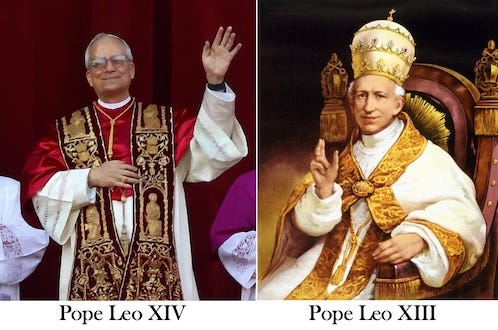
Today the Vatican released “Magnifica Humanitas” Pope Leo XIV’s anticipated first encyclical applying the principles of Catholic social teaching to artificial intelligence. It was signed on the 135th anniversary of Pope Leo XIII’s 1891 encyclical “Rerum Novarum.” The two encyclicals are both expressions of the Church’s tradition of adapting to radical societal shifts. “Rerum Novarum” (“Of New Things”) offered as a guide in regard to the social and economic impacts of the Industrial Revolution; addressing how unregulated capitalism and industrialization can concentrated wealth and power at the expense of the poor “Magnifica Humanitas” explores the “new things” of the digital revolution, transhumanism, and artificial intelligence; warning that unmanaged AI may concentrate power in the hands of a few and marginalize displaced workers. Both focus us on the sacredness of the human person. Leo XIV rests on the central tenets of Catholic social doctrine that assumes that the well-being of all individuals is intertwined and that economies and technology must serve the common good.
From “Magnifica Humanitas”
The primary choice is not between a ‘yes’ or ‘no’ to technology, but rather between constructing Babel or rebuilding Jerusalem; between a power that claims to dominate the heavens and a people who work together in the presence of God to rebuild the walls of fraternal coexistence.
As with every major technological shift, AI tends to amplify the power of those who already possess economic resources, expertise and access to data … In light of the common good and the universal destination of goods, this raises serious concerns, since small but highly influential groups can shape information and consumption patterns, influence democratic processes and steer economic dynamics to their own advantage, undermining social justice and solidarity among peoples.
Anglican thought
Added June 12, 2026 - “Anglicans respond to ‘Magnifica Humanitas’, the new encyclical by Pope Leo XIV”
“The Pope is correct that there is a danger here. It is concerning that a few companies, individuals no less, hold a lion’s share of the world’s data and power. Such powers and institutions, easily taking on a life of their own and using the very people they promise to serve, are not new. We are creatures, never gods. The encyclical is a gift, and as global Anglicans, we receive it with gratitude and learn from its clarity. Yet we must offer our own word on AI rather than echoing the Pope.’ (The Rt Revd Andrew Doyle, Episcopal Bishop of Texas)
Anglican Identity in the Age of Artificial Intelligence
The Anglican tradition emphasises the inherent dignity of every human being, a concept that must guide the development and use of Gen AI technologies. Ensuring that Gen AI systems respect human dignity involves safeguarding privacy, promoting fairness, and preventing biases that could lead to discrimination. … One of the central tenets of Anglican social teaching is the promotion of the common good. This principle can serve as a guiding star for the ethical use of Gen AI, with Gen AI technologies being developed and implemented in ways that contribute to the welfare of all individuals, particularly the most vulnerable. This means ensuring that Gen AI does not exacerbate existing inequalities; indeed, on the contrary it should be designed to help bridge gaps in access to resources and opportunities.
Synod affirms work as key to ‘human dignity and purpose’ in the face of AI revolution
The Synod statement
mindful of the deep economic effects of the pandemic, the impacts of new technology, and the global rise of new forms of working
A. affirm the dignity and value of purposeful work, whether paid or unpaid, as a significant component of human flourishing;
B. endorse the Rome Call for promoting an ethical approach to Artificial Intelligence (AI);
C. endorse and commend the five principles used for evaluating fair and dignified platform work in the gig economy by fair work;
D. encourage all parishes, benefices, dioceses, cathedrals, Theological Educational Instituions and other Church of England organisations to implement, at a minimum, the living wage for employees and to have a regard for work/life balance and dignity at work; and
E. call for the Faith and Order Commission (FAOC) together with Mission and Public Affairs Committee to advise on what is essential to purposeful, dignified, and fair work in the context of the fourth industrial revolution now in progress including specific advice on how these changes impact the work of women and to look at Biblical wisdom on work, employment and economy in its widest sense; and to consider a range of practical solutions from recent economic thinking in harmony with the Christian tradition's emphasis on grace, justice and mercy, such as questions around pay ratios within organisations, Basic Citizens' Income, poverty and wealth lines, to strengthen our Christian voice in the public square as a Church.
Others
This section is an addition done after the initial posting. The critiques on-line take a variety of forms. A concern that his call to "slow things down" risks killing the "miracles" and life-saving advancements AI could bring to medicine, science, and efficiency. Others note that the Pope Leo is sidesteping the "grand humbling" of humanity in refusing to engage with the reality that machines may soon surpass human intelligence in areas we take pride in. There is also the view that his views on modern warfare are geopolitically naive and could leave nations defenseless against adversaries who refuse to follow the Pope's guidelines.
Pope Leo’s AI Manifesto (WSJ) “While AI isn’t without risk, government control is likely to result in an even greater concentration of power. Regulation tends to protect incumbents and retard competition. Repressive regimes can also use AI to suppress dissent, as China’s Communist Party uses AI to surveil and censor its people.”
Pope Leo XIV Takes on the Silicon Valley Oligarchy (The New Republic) “Until Pope Leo XIV’s election last year, the consensus among Vatican experts was that the cardinals would never elect an American pope, to avoid concentrating too much worldly power in the world’s last superpower. But rather than exalt American hegemony, Leo has sharply challenged and criticized it within the teachings of the church. Magnifica Humanitas is about not just AI and other Silicon Valley inventions, but the damage they have wrought upon us all.”
Where I began
There will be arguments in the political, cultural, business, and theological spheres. We may each find ourselves swinging back-and-forth among the various opinions. We may find ourselves fearful or hopeful. The case I would make is that we focus first upon what we are in control of and offers us the possibility of wisdom - the habits of prayer and listening and a stance that is “largely balanced and judicious.”
O risen Christ, ascended Lord,
All praise to thee let earth accord,
Who art, while endless ages run,
With Father and with Spirit one.
(From Bede’s Ascension hymn)
This abides,
Brother Robert, OA
The Feast of Bede, Priest, and Historian, 735
Parish development - Social ethics - Spiritual life
Pictures in the public domain Pope Leo XIV and Pope Leo XIII


RELATED