
Trust development model
Say "Good morning!"

And all of you must clothe yourselves with humility in your dealings with one another (From 1 Peter 5)
I like it when someone passing me on the street says, “Good morning” to me. I get a warm feeling. A bit more alive. Sometimes I’m delighted. Same thing in my apartment building. Most of us don't know each other's names. But when we get on the elevator, there's almost always an exchange of greetings and when someone gets off a “have a good day.” A homey and comfortable feeling.
Behavioral science not morality
My focus in this article is on the behavioral science of the thing rather than the morality of it. I could make a case that saying “good morning” is an affirmation of human dignity. Which isn't to say that not saying good morning is a rejection of human dignity. There are many reasons why people don’t initiate or respond to a greeting. They might be preoccupied with something else, tired, busy, or just not in the mood. Online I found someone describing their experience of a difference between American and Irish young people. Janis Collins began with, “I definitely noticed a difference moving to Ireland. Irish kids (let's say 10 to 16) are nicer, more courteous and almost always return a hello or a wave, just as the adults do. They look at you. … In America, unfortunately, many young people are standoffish, if not rude. They don't seem to know how, or many times, want to interact with an adult. Also, in America I've had kids be intentionally obnoxious. I've had many a young person flip me off. They are especially rude when in groups.”
So there are reasons for not saying “good morning.” There are usually reasons for murder too. Yes, I know. Over the top. So let's set morality issues aside, and look at the behavioral science of it.
Trust Development Model
Back in the late 60s and 70’s when I was learning about group and organization development I spent a lot of time with Jack Gibb’s theory work on trust development. One part of his thinking was about the tension between “wants” and “fears.” For example, we want to be included and to trust others and we fear rejection. The pattern went through stages and ended with a “want” around having some influence and control in life and a fear of being manipulated and helpless. I used his theory in a chapter in my masters thesis from my degree in organization development. In various presentations, I had developed a way of explaining the theory as a set of building blocks that if not properly arranged could tip over. I drew on Gibb's theory and my own modifications in developing the Trust Development Model. (Also see “Trust Development in Organizations” [1]
The model begins with “Inclusion and acceptance” and ends with “Internal Commitment, Collaboration, Self‐ management.” We start with acknowledging people we are in the room with, a “hello norm.” The assumption is that the blocks build, one upon the other — Inclusion and acceptance into open information and onto shared direction (established after exploring choices). To the extent each stage is adequate we may arrive at a group or organization that has a high degree of internal commitment, collaboration, and self‐ management.
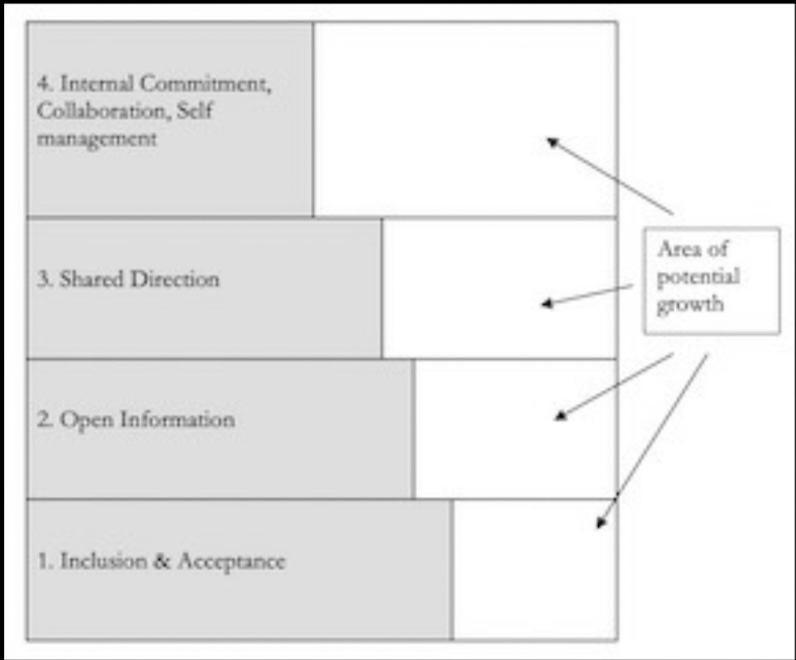
We begin it all with “Good morning!
For the fully Christian life is a Eucharistic life: that is, a natural life conformed to the pattern of Jesus, given in its wholeness to God, laid on His altar as a sacrifice of love, and consecrated, transformed by His inpouring life, to be used to give life and food to other souls. Evelyn Underhill
This abides,
Brother Robert, OA
The Feast of Phoebe, Deacon
[1] More on the Trust Development Model in Finding God in All Things: Contemplation, Intercession, and Intervention in chapter 5 and in In Your Holy Spirit: Shaping the Parish Through Spiritual Practice chapter 6.