

This article comes from Chapter One of An Energy Not its Own: Three Cycles of Parish Life and the Purposes of the Parish Church
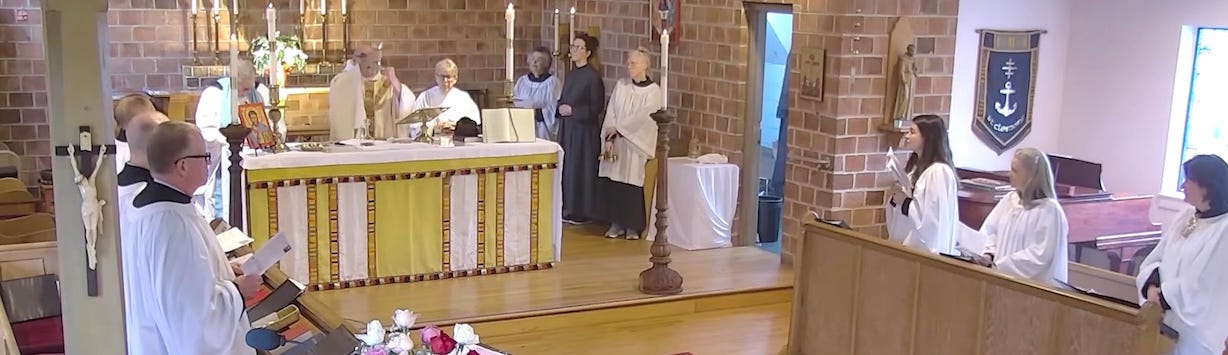
The disciplined, prayerful, listening Christian community, located in a specific place … tries to understand and respond to the challenges of its immediate context … it is rooted in the worshipping and corporate life of actual communities; it begins with concrete and specific issues and moves outwards; and it overcomes the syndrome of a facile optimism in which we seek to deal with problems over too wide an area, at the level of general principles and moral rhetoric, and then gradually move to a cosmic pessimism, which abandons any hope of change of any kind. – Kenneth Leech
There are three intrinsic purposes of any parish church. We see them as:
The worship of God
The formation of the People of God for the sake of the world
Being a sanctifying presence in the broader community
These purposes aren’t something we create ourselves. They are the innate, natural functions of the local microcosm of the Body of Christ, the parish church.
The parish that faithfully takes on the purposes does so as an extension of the Incarnation. The mission of God is our mission—holy unity, reconciliation. The ends of God are our ends—the Kingdom, “a commonwealth of free, responsible beings united in love.” The parish’s attention to the three purposes is about advancing that mission and those ends.
The worship of God
We become what we love and who we love shapes what we become. – Clare of Assisi
Worship is what human beings do. It comes naturally to us. We are wired for adoration, awe, and reverence. … The worship of God is for its own sake. It’s not about there being some benefit for ourselves or for the world, though there is a benefit. We enter into adoration and awe and in doing that we engage what we were created for—our “chief end is to glorify God and enjoy him forever.”
The formation of the People of God for the sake of the world
Spiritual formation prepares us for a life in which we move away from our fears, compulsions, resentments, and sorrows, to serve with joy and courage in the world, even when this leads us to places we would rather not go. Spiritual formation helps us to see the face of God in the midst of a hardened world and in our own heart. – Henri J.M. Nouwen, “Spiritual Formation: Following the Movements of the Spirit”
The scriptures have a great deal to say about maturity, sometimes called perfection. We are especially fond of this: “Beloved, we are God’s children now; what we will be has not yet been revealed. What we do know is this: when he is revealed, we will be like him, for we will see him as he is. And all who have this hope in him purify themselves, just as he is pure” (1 John 3:2–3). We are of course something right now—we are God’s children. That’s a place to begin. In a world often obsessed by issues of identity we hear that our primary identity is that we are a child of God. And we don’t get to know a lot more than that. So, we are invited to humility, and we are given one more piece: In the end we will be like him. This does, though, mean that we aren’t there yet, and that is often at odds with the broader culture. We frequently hear an insistence that we are either on the “right or wrong side of history” (and that it’s possible to know such a thing). At the same time, many struggle to embrace any sense of truth outside of their own feelings, preferences, and judgments. The Christian assurance that we are God’s children now and will ultimately be like him requires more humility in the present, more hope for the future, and less certainty that we’ve worked it all out already. This is central to questions of formation.

Being a sanctifying presence in the broader community
There is nothing so contagious as holiness, nothing more pervasive than Prayer. This is precisely what the traditional Church means by evangelism and what distinguishes it from recruitment. – Martin Thornton
The primary sanctifying relationship of any parish is through the presence of the baptized members scattered into the arenas of daily life—family and friends, workplace, and civic life.
The second most common sanctifying relationship is by the parish as a body with the community of people living in the area of the parish—a city neighborhood, a small town, a sprawling suburban community. There are other relationships with external communities for many parishes. Some churches are “destination parishes” that attract people from all over the region because of their liturgy, preaching, witness, or history. Others have a connection with a vocational community such as the performing arts, the medical practitioners, or the volunteer fire department.
It may be useful to think of this sanctifying presence in terms of relationship rather than service. Too many parishes have a semiconscious image of themselves as service providers. Religious social workers. It’s as though doing for others legitimates their existence. Relationship seems a more accurate word. In as much as the parish is a people and place of prayer, a people and place in relationship with God, that will flow into the parish’s relationship relationship with the neighborhood or town or other external community of people.
The three primary tasks of a diocese
While we’re looking at the three purposes of a parish it might be useful to add a few words on the primary tasks of a diocese. We see three areas that constitute the essential work of a bishop and a diocese.
The development, renewal, and revitalization of parish churches.
The bishop needs to help all the parishes be communities that live and worship to the glory of God and in which the baptized are formed as instruments of God’s love in families, the workplace, with friends and in civic life. And each parish is a vibrant sanctifying presence in its community.
Engaging the region of the diocese.
The diocese can work for justice and compassion, in that state or city, on its own, as well as in cooperation with parishes and in collaboration with other denominations.
Connecting the diocese with the larger church.
The bishop is an essential connection with the national and international life of the Episcopal Church and the Anglican Communion. The bishop also has a responsibility to help parishes be grounded in the Anglican ethos.
The parish includes … the horses and cattle, the dogs and cats, the fields and woods, the schools, and businesses—the whole kit and caboodle. Of course, I’m talking mostly about the people, but give me a bit of leeway here. It’s sort of biblical, like Jonah talking about Nineveh: “And should I not be concerned about Nineveh, that great city, in which there are more than a hundred and twenty thousand persons who do not know their right hand from their left, and also many animals?” – Loren Mead
This abides,
Sister Michelle, OA & Brother Robert, OA
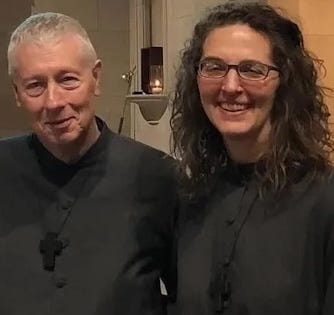
An Energy Not its Own: Three Cycles of Parish Life and the Purposes of the Parish Church, Michelle Heyne, OA & Robert Gallagher, OA
RELATED