
The God That Failed
"To create a sense of the hunger for life that gnaws in us all, to keep alive in our hearts a sense of the inexpressibly human." Richard Wright

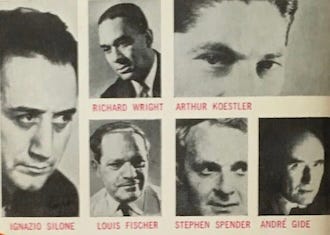
The God That Failed: Why Six Great Writers Rejected Communism was published in 1949, I was 5 years old. I didn’t read it then and I still haven’t read it. Maybe I will now. Two of the six writers are familiar to me, Stephen Spender and Richard Wright. Spender knew Auden, Elliott and Hemingway. He became a member of the Communist Party of Great Britain in 1936. He was very disturbed by events such as the Molotov–Ribbentrop Pact and the brutal purges brought on by Soviet-backed communists in Spain. He was an idealistic supporter in the 1930s and became an anti-communist during the Second World War. He had become a communist because of his humanism and became disillusioned when he realized that the reality of the movement and Party clashed with individual conscience and creative freedom. Richard Wright wrote Uncle Tom's Children (1938), Native Son (1940), and hundreds of novels, stories and poems. He knew Langston Hughes, Jean-Paul Sartre, Albert Camus, and Ralph Ellison. He joined the American Communist Party in 1932 and left in 1944. He resisted CP leaders telling him what to write and ended up thinking that the rigid climate of the Party was as suffocating as the racial and intellectual oppression he opposed. Three of his books are on my shelves. I read two of them in the late 60s when I was going through my passion over James Baldwin. Spender and Wright left the Communist movement while remaining supporters of the left.
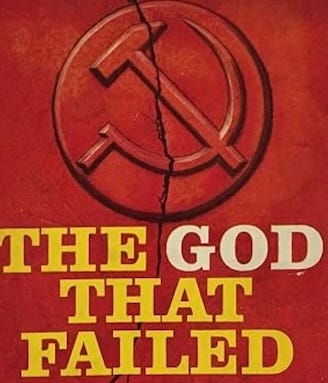
In The God That Failed: Why Six Great Writers Rejected Communism each writer tells a story of attraction and betrayal. How they were attracted to the Communist movement and party because they saw it as fighting for economic justice, equality and against the fascism of that age. Each had a specific moment when their belief was shattered. The title, “The God that Failed,” was a metaphor for how Communism demanded a religious-like faith from its followers.
I have been involved in left-wing causes most of my life. Even though I was never attracted to the Communist Party I had my own moment of fully expected “betrayal” when I was twelve. In 1956 Hungary there was a spontaneous uprising against the communist government that had been imposed after the end of the War. A peaceful student protest in Budapest escalated into armed conflict after security forces fired on civilians. There was a moment when the free world and the Hungarian people knew freedom and saw the Soviets withdraw from the country. Imre Nagy became Prime Minister, dissolved the one-party communist system, and formed a new government. A few days later thousands of Red Army troops and hundreds of tanks poured into Budapest and crushed the rebellion. I remember watching it on on our black and white television set. My working class family wondered why Eisenhower didn't do something. If I needed any reinforcement, it came in 1968 when Czechoslovakia sought to shape "socialism with a human face" and saw the invasion of 200,000 troops to destroy the experiment.
“The Return of the God That Failed” was posted today in The Free Press by Gary Saul Morson, a Professor at Northwestern University. Morson suggests that there is much to learn about the dynamics involved in the religious claims of current utopian ideologies from the old book of 1949. He writes,
As a Russian specialist, I cannot help wondering: How is this possible? Do these people really have no problem with the history of the ideology they’re claiming? With Joseph Stalin’s Gulag that took the lives of millions, his artificially induced famine that deliberately starved several million peasants, and the secret police’s form of interrogation that routinely included torture? Do they actually want to revive Mao Zedong’s Cultural Revolution and the Khmer Rouge’s reign of terror that claimed the lives of a quarter of Cambodia’s population?
He explores how in the old Communist movement and in much of today’s far left movement we can see “the readiness to give up one’s own judgment…whenever it conflicts with the judgment of the Party. Slogans and formulas became the means to this end, wielding hypnotic power when repeated over and over again, especially in the presence of others doing the same thing.”
It is a kind of echo of Pope Leo’s concern about ideologies that have been noted in other pieces here. “In the end, they always undermine human dignity. “He argued that ideologies reduce the richness of human life to a single idea, offering a false sense of clarity by oversimplifying the world. For the ideologue, this illusion of certainty replaces the ongoing pursuit of truth, and the uncertainty through which faith must guide Catholics.” (in South Bend and the Holy See). The Pope has critiqued the rise of modern, especially Western, ideologies that undermine human rights and religious freedom. He takes a rather standard Christian approach that sees social doctrine, or social ethics, as a ‘way of seeing reality illuminated by faith and reason’ rather than a set of slogans or political programs. The church’s concern is with the nature of God, the dignity of human beings and the virtues and gifts of faith. The task is to base our social teaching on those things rather than a utopian scheme. In his January 2026 'State of the World address, Pope Leo spoke of an ‘Orwellian-style’ language being used in support of ideologies that claim inclusivity while excluding those who do not conform with the ideology. That leads to a condition in which basic freedoms around conscience and speech are restricted. He has cautioned about the immorality of indoctrination because it ‘stifles critical judgment and undermines the sacred freedom of respect for conscience.’” Pragmatism, ideology and faith

Morson seems aligned with the Pope as he compares the old movement with the new one:
There is no such thing as neutral, objective truth, irrespective of political interests. Truth was whatever was useful for the Party to regard as true. “This way of thinking canceled out all experiential objections,” Spender explains: “The thousands of people in prison camps. . . . Do these exist? Whether or not they do, it is bourgeois propaganda to maintain so. Therefore one must deny that there are any slave labor camps in Russia,” and that’s all there is to it. … Today, post-structuralist thought offers a version of this idea: There is no such thing as objectivity, only one or another point of view. So long as what one says suits the right interests, it cannot be a lie.
Morson continues with how the six writers of 1949 “discovered that their greatest loyalty was to the truth, in part because anything else insulted the memory of millions of victims and in part because they found it impossible to sacrifice their identity as writers.” And he close with Richard Wright.
I was most moved by Wright’s loyalty to writing. No demands of social justice could make him false to the honesty that his craft required. “My writing was my way of seeing, my way of living, my way of feeling; and who could change his sight, his sense of direction, his senses?”
For behold, you look for truth deep within me, *
and will make me understand wisdom secretly. (Ps 51)
This abides,
Brother Robert, OA
Parish development - Social ethics - Spiritual life - Order of the Ascension
RELATED