

A PDF of this article
The history and issues of the Church Development Institute (CDI) are just part of the story about how the Episcopal Church arrived at where we are in effective parish development training programs. CDI is the intermediate piece between the organization development (OD) program of MATC (Mid-Atlantic Training and Consulting) in the late 60s and into the 70s and todays’ three primary parish development training programs (2008 to now). I’ve been deeply involved through all that history. You may find it helpful to look into my background in the field — scroll down the names here.
So, let’s begin with where we are now.
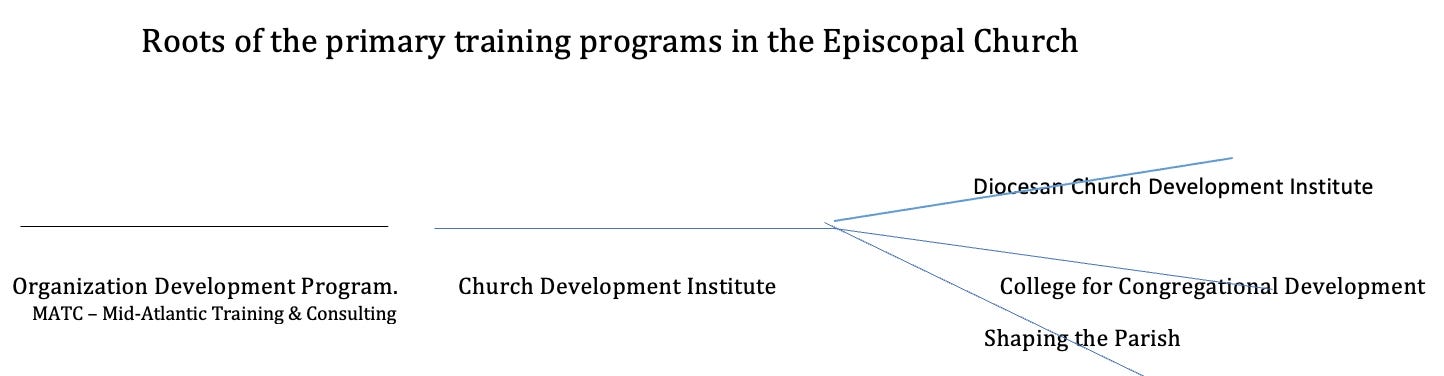
Currently there are three active training programs that offer a solid foundation in parish development. They have shared roots. The Diocesan Church Development Institute with its origin in 1978. The College for Congregational Development started in 2009. Shaping the Parish, a third program, was active from 2011 - 2012 and restarting with a different format in 2023.
What’s the evidence that these programs are effective? Participants in all three programs say they have helped in their efforts to improve parish life and work. I’m only aware of one study that shows results. In the late 1980’s I did a comparison of parishes participating in CDI and those not participating.
In the late 1980s the Diocese of Connecticut required all of its small, struggling, financially-aided parishes to participate in processes of self and peer reflection and assessment, meet together on a regular basis, and make use of a trained consultant. As new priests were appointed they were required to complete an early form of CDI, in addition to the other requirements. Over a five-year period parishes with leaders participating in the CDI training program experienced 80% average pledge increase (vs. 68% for non-participants) and 24% in attendance (vs. 15%). All these parishes reported increased satisfaction with the central elements of parish life, e.g., worship, formation, service, evangelization, etc. This occurred while the state’s population was declining and as the percentage of the diocesan budget allocated to financial aid to these was also declining. (From “Understanding from Within: Working with Religious Systems”)
The three programs have never engaged enough dioceses and parishes to significantly impact the general decline of the Episcopal Church. Also from the 2015 article mentioned above -
Over the last 20 years 18 US dioceses (of 99) and one Canadian (of 34) have made use of these programs. There have also been hundreds of individuals attending national expressions of the programs. Around half of those dioceses have engaged the programs for enough years to see a significant impact on their parishes.
Things have improved since then, but not by all that much.
The history of CDI
In the 1970s The organization development program of the Mid-Atlantic Training and Consulting system (MATC) trained several thousand people in organization development. I and others from the Diocese of Pennsylvania went through the program and found it very useful. However, we had a sense that it did not adequately connect with an understanding of what was unique about the parish church as an organization and it failed to draw on the resources of aesthetic theology. So I created what became the Church Development Institute (CDI) to make those connections. All the current programs draw on that history and make an effort to offer both sound organization development and related ascetical theology. The program has had different names over the last 48 years. I’ll often use the CDI name for all those efforts.
What became CDI, started in 1978 in the Diocese of Pennsylvania as part of a consultant training program. As now, it was a two-year program. The participants also had to complete 3 or 4 MATC labs in human relations, group development and experiential education design skills. I designed and led the program. It was part of a broader arrangement I had with the Diocese in which they covered the cost of my continuing education in the field in exchange for me devoting time to the development of an internal consulting network. There were six participants in that program. We covered the same basic information on organization development seen in the MATC OD program. The change came in three areas. The gathering always included the daily office or Eucharist. We explored the dynamics and results of interventions in Episcopal parishes. And we began to use models ground in an Anglican aesthetic theology. The first such model was the Christian Life Model. I first introduced the model as a module within the MATC OD program.
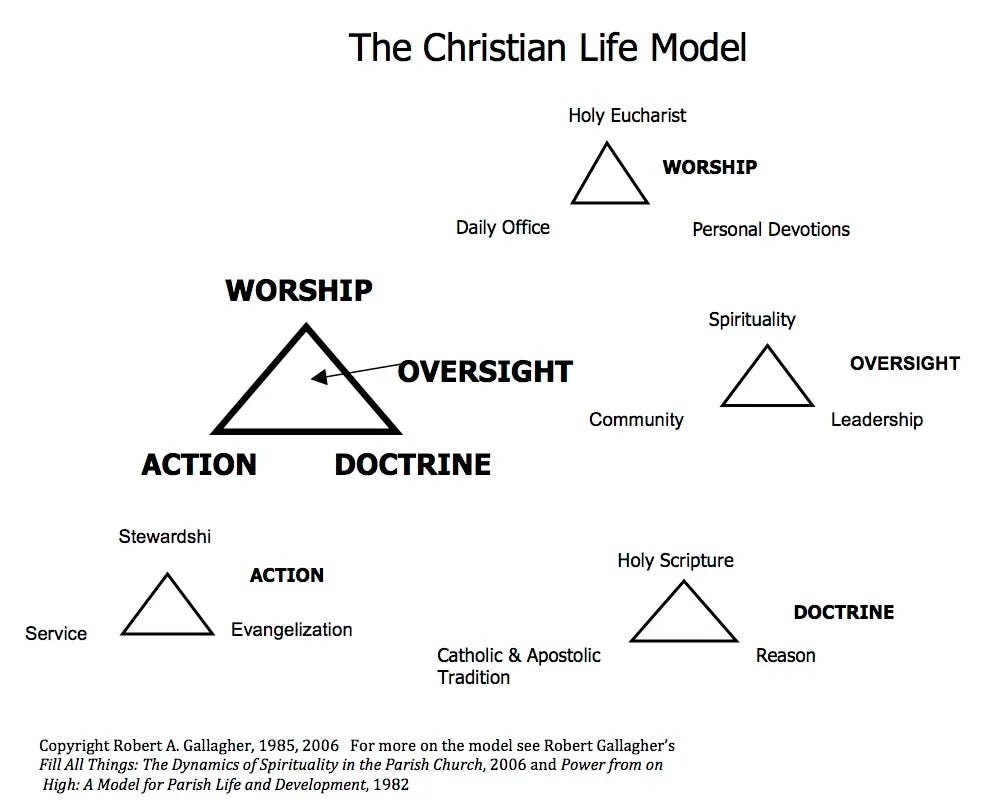
Fill All Things: The Dynamics of Spirituality in the Parish Church (2008) includes the Christian Life Model as one of the four core frameworks. There is a chapter with the latest version of the model.
I moved to Connecticut to join the bishop’s staff in 1981. In Connecticut the question became whether to offer the program for just consultant training, as it had been in Pennsylvania, or to broaden it and involve parish leaders. The decision was to broaden it. We thought if we could get 10 people to spend two years in the program it would be worth it. That first year we had around 70 participants split between a morning session in Hartford and an evening session in New Haven. It was used to train parish leaders as well as diocesan consultants (1981 - 1993, and 2000). When I left Connecticut in 1988 to return to parish ministry, the program continued for some years after that. Later when CDIs started in other dioceses the Connecticut program became part of that national system.
The Order of the Ascension (OA) has its beginnings in 1981 as several Philadelphia priests and lay leaders began to pray and think about the formation of a dispersed Benedictine religious order with a mission around parish development. The Order would go on to co-sponsor with the General Seminary the first national CDI, create Ascension Press to publish related books, and offer a variety of in-person and online programs. More on OA history. Picture is from the 2026 retreat.

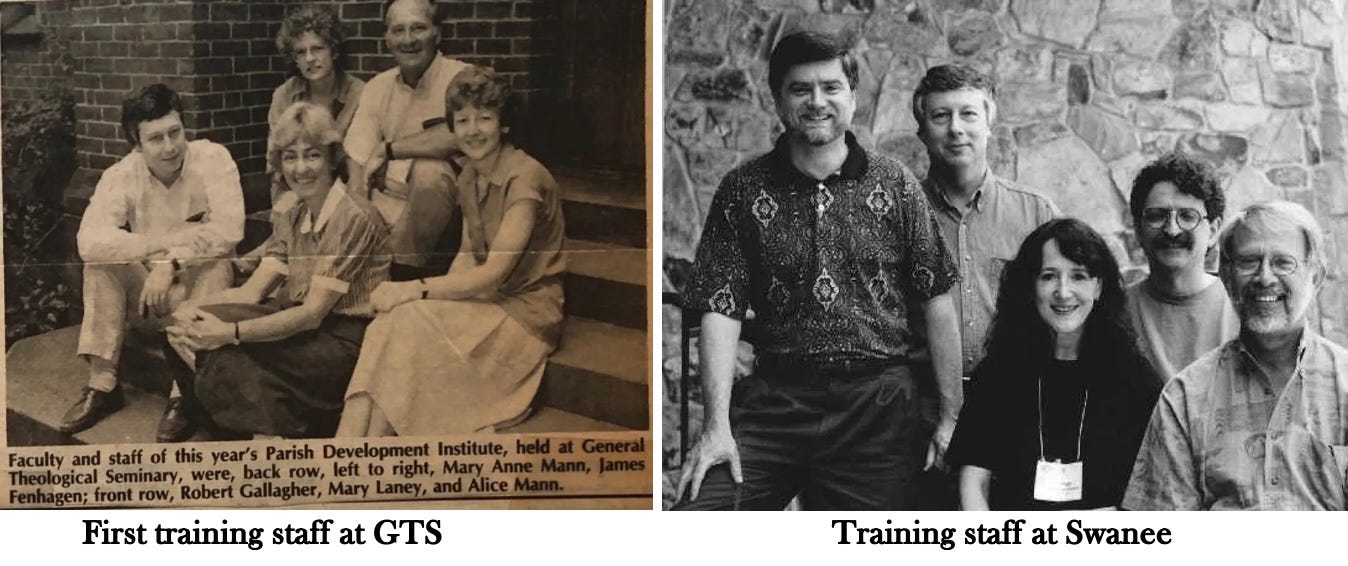
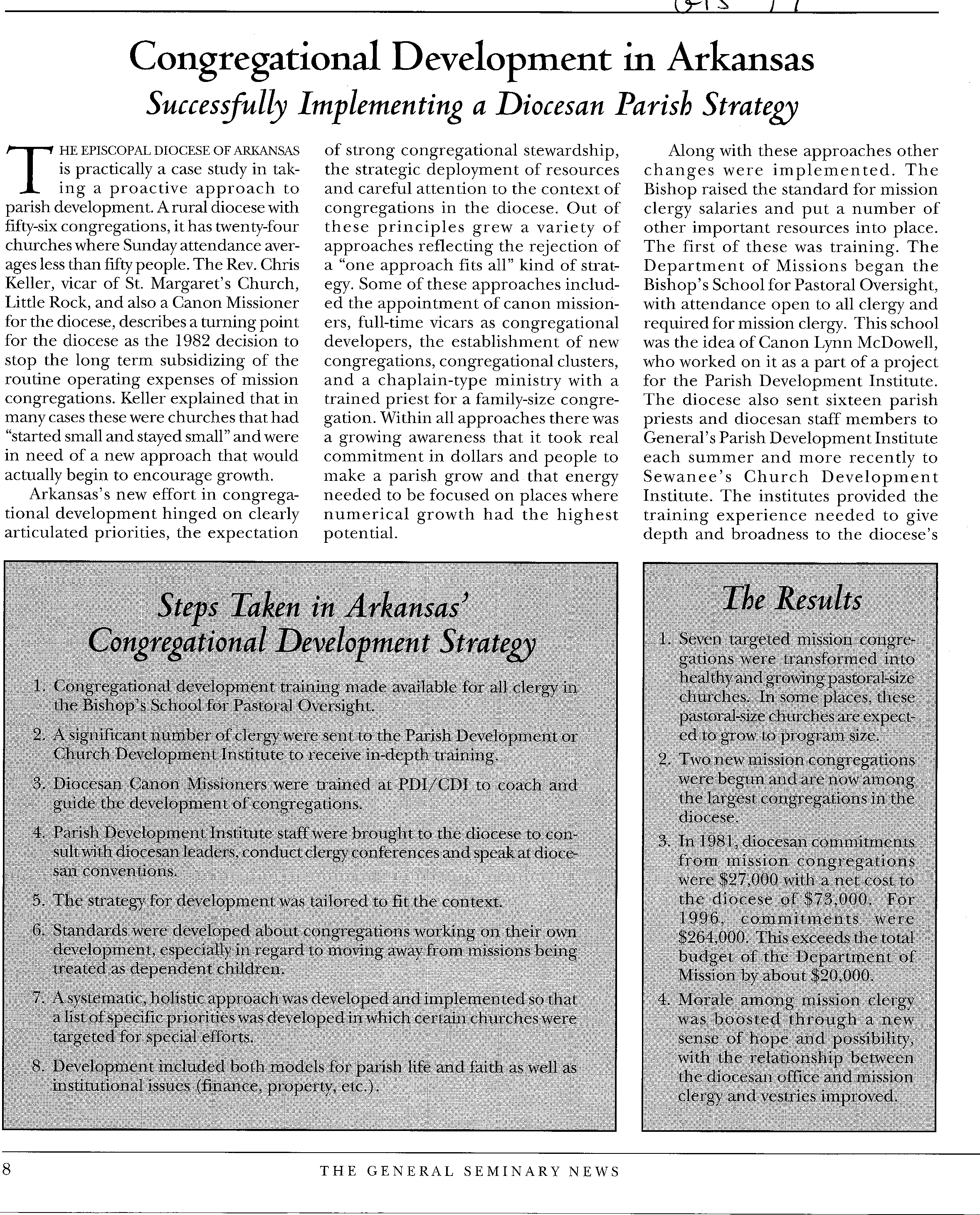
In 1985 a national CDI began. The Parish Development Institute (later the national CDI) was started at General Theological Seminary (GTS). It was co-sponsored by the seminary and the Order of the Ascension (OA). This became the first intensive and broad training resource in parish development for the Episcopal Church. The national CDI was at GTS from 1985 - 2000. Then we stayed in NYC for two years at St. John’s in the Village. It then moved with me to Deer Isle, Maine and later to Seattle. The training was much the same in all those locations. When in NYC and Seattle on Wednesday evening everyone would go out to eat together at a local restaurant. On Deer Isle we'd have a lobster cookout. The GTS program was co-sponsored by the seminary and OA (from 1985-1995) and transitioned fully to GTS responsibility for the following five years. The national CDI was two summer weeks one year, application in the parish in between, and two weeks for a second summer. A 1986 article on the national program. 1984 OA letter to James Fenhagen to begin national CDI at GTS One of the most effective uses of the program is seen in the “Congregational Development in Arkansas: Successfully Implementing a Diocesan Parish Strategy.”
The Rev’d Loren Mead wasn’t directly involved with CDI. But he serves as a general example of how so many people contributed to the program, often without knowing it. Loren was a catalytic and connecting force of ideas and people. His work in Project Test Pattern, and later Alban Institute, brought the applied to behavioral sciences to play a greater role in the church's life. Action-research, consulting networks in dioceses, effective training programs = Loren played a role in all of it. The most direct contribution to CDI however was made several years before CDI existed. He connected me and Jim Fenhagen who was then the rector of St. John's Episcopal Church, Georgetown Parish in Washington, D.C. Jim served as a primary bridge between the applied behavioral sciences and the mid-to-late 20th-century American church. Through his involvement with organizations like Mid-Atlantic Training and Consulting (MATC), Fenhagen helped reshape how the church approached leadership development and parish organizational health.
The Rev’d Melissa Skelton came to GTS in 1993 to serve as Vice President of the seminary. She sat in on a few sessions of CDI and recommended to the president, Craig Anderson, that the program be continued and strengthened. It was the perfect moment. We'd been experiencing a decline in the number of participants. I was wondering whether we had used up the market for what we had to offer and maybe it was time to close shop. Melissa had extraordinary skills in marketing. She had an MBA from Chicago and years of experience at Proctor and Gamble. She applied those skills as part of the seminary’s support of CDI and the numbers shot up. Around the same time, I was taking courses in nonprofit management at Rider University and NYU. So while I could not have done what Melissa did, I had learned enough to understand and cooperate with it. Melissa went on to play a significant role in the formation of CDI Trainers and later to found the College for Congregational Development.

A second and larger national CDI began at the Sewanee School of Theology in 1995 under the leadership of Peggy Bosmyer Campbell and Dennis Campbell. The General and Sewanee programs joined forces and did joint advertising and educational design work. The program located at GTS ended in 2000 and the one at Sewanee closed around 2004.
Both programs frequently heard assessments from participants like this -
“Learned more about myself - how / operate.
More about my parish and parishioners.... Beginning to have a more comprehensive understanding of the PARISH AS A SYSTEM.”
“Learning to recognize that / can’t change everything overnight.”
“Hope! Courage!.... An awareness of the complexity of parish life.... Clear model for parish development.”
“The continual reinforcement of centering everything in Christ and the nature/mission of the Church.”
“Knowledge to really look at the parish - this has been a painful process for me.... Progress can be slow - patience is a virtue.
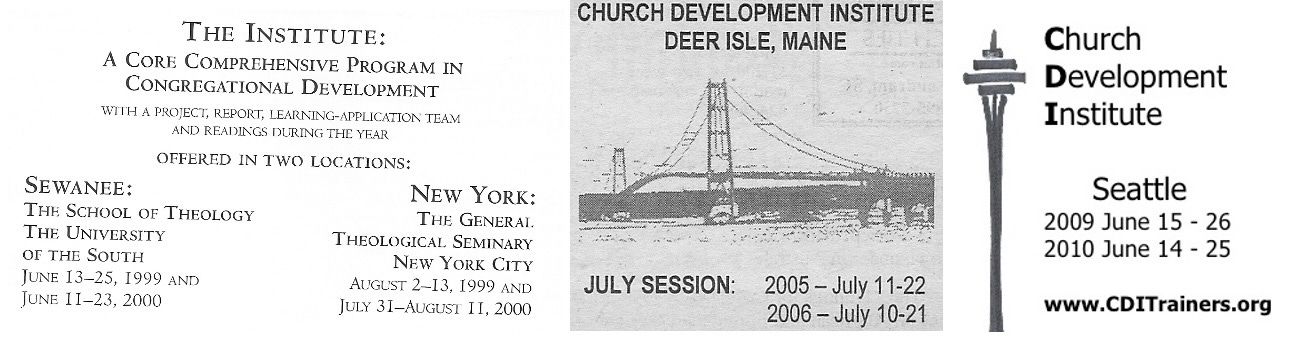
In 1999 we made a decision to create a system of diocesan CDIs. Over the years, within the CDI Trainer system and then Diocesan CDIs. There have been 20 diocesan CDIs -- Atlanta, Connecticut, Milwaukee, Newark, North Carolina, Northern Indiana, Rochester, Southwest Florida, Southwest Virginia, Virginia, Washington, Western New York, Western Massachusetts, Georgia, Utah, Eastern Michigan, Western Michigan, Long Island and Southern Virginia. The last two are still operating.
In 1999 CDI Trainers was established. That group oversaw both the diocesan CDIs that had developed and the existing national programs (Sewanee and the former GTS program then CDI-NYC). Letter initiating CDI Trainers formation. Founding Charter The first annual gathering was in 2001. Twenty two of us met for three April days at Camp McDowell, Alabama to create social glue among us, give structure to diocesan CDIs, work on marketing, and develop a functioning team. When we met in 2002 we had four diocesan CDIs and the 2 national CDIs functioning. All the CDIs had a common participant manual (2008 update) and required reading list (from 2004)
LTI (Leadership Training Institute) became part of the CDI Trainers system in 2008. At that time there were 33 CDI trainers and interns and in LTI 6 senior trainers, 3 co-trainers and 16 interns. Here’s a PDF on how we understood the categories of trainers.

The Leadership Training Institute was offering training along the same lines as MATC during the 60s and 70s. It was led by The Rev’d Bill Yon a priest in the Diocese of Alabama. LTI stopped functioning around the same time as MATC closed. In 1998 Bill worked with Loren Mean to organize the Next Hurrah Conference at Kanuga. They brought together lab trainers from the old MATC and LTI systems. The conference resulted in a period of renewed lab training. From that meeting came the use of T-groups in the summer Church Development Institute and Shaping the Parish programs, a restart of Bill Yon’s LTI (Leadership Training Institute), and Roy Oswald’s EQ/HR (The Center for Emotional Intelligence and Human Relations Skills). CDIs increased the amount of experiential education within the program with a new emphasis on role play, structured feedback among participants and a disciplined process of reflecting on experience (the EIAG method). I became a trainer in the renewed LTI and after Bill stepped down from leading the group I became the coordinator and eventually brought it into CDI Trainers.
All CDI’s offered at least 110 workshop hours, common daily worship, required readings, the development of projects, reports on the projects, and participation in a participant Learning-Application Team between sessions. Diocesan CDI’s tended to draw parish teams of lay and clergy leaders.
CDI Trainers and the earlier forms of CDI also sponsored workshops and forums that focus on particular issues and skills. On occasion these workshops have helped individuals generate new or enhanced offerings for the church—Rob Voyle’s appreciative inquiry efforts have roots in his first encountering AI at a CDI workshop at Sewanee; the work of Gretchen Pritchard with children and families and Jane Tomaine in the “Benedictine Toolbox” also had connections with early CDI work. CDI Trainers efforts through the Leadership Training Institute were a continuation of that workshop tradition.
In 2011 CDI Trainers was closed. The existing diocesan CDIs created a new organization - Diocesan CDI in a desire to simplify and focus their work. The LTI and national CDIs shut down (more about that below.). Long Island and Southern Virginia have very successful programs.
Four transitions
I want to explore four transitions that occurred over these years. First, the integration of ascetical theology. Second, the development of a particular dense learning culture . Third, the decision to create the diocesan CDI's. Fourth, the impact of closing CDI Trainers.
1. The integration of ascetical theology
Many in the church were finding the use of applied behavioral science theory, and methods helpful in parish life. Significant numbers of clergy and lay leaders were trained. At the same time many of us had sensed that the training and related books did not adequately connect with an understanding of what was unique about the parish church as an organization and it failed to draw on the resources of aesthetic theology. So, a shift emerged.
A blending of pastoral and ascetical theology with Organization Development. In relation to parish development this began in 1978 with the creation of what later became the Church Development Institute (CDI). In 1982 Ascension Press published my first book on the Christian Life Model, Power from on High: A Model for Parish Life and Development, which was an early attempt to connect the threads. Over the next few years I developed three additional “core models” - The Benedictine Promise (1987), The Renewal - Apostolate Cycle (1985), and The Shape of the Parish (with Mary Anne Mann,1983). Fill All Things: The Spiritual Dynamics of the Parish Church (2008) has a chapter on each model.
Early CDI’s made significant use of the work of Bruce Reed‘s The Dynamics of Religion (see “Task of the Church and the Role of its Members” for a short version), Jim Anderson‘s To Come Alive! New Proposal for Revitalizing the Local Church [1], Martin Thornton’s books [2], and Urban Holmes’ The Priest in Community.
As Martin Thornton’s thinking developed, he discovered the behavioral science work of Bruce Reed from the Grubb Institute on oscillation theory (extra-dependence – intra-dependence) and wrote about it in Spiritual Direction in 1984. The same year saw Thomas Oden’s Care of Souls in the Classic Tradition where he turns to the “classical Christian pastoral tradition” in exploring the thinking of Gregory the Great as a more integrative approach to pastoral practice than he saw in the behavioral science methods he had worked with in the 70’s.
The more recent Shaping the Parish series of books continues the effort and offers a more complete course of material that brings together ascetical theology with the applied behavioral sciences, especially organization development.
The shared experience of many church members going through the lab and OD training offered in the 70’s and early 80’s was that while the skills and methods were very valuable, there was not an explicit exploration that related the theory and methods to faith and practice. The Church Development Institute was the first program that addressed that issue in a significant manner.
One participant in the 1976 MATC OD training shared his experience this way
Other than Verna Dozier, there was no other trainer/consultant who spoke of the spiritual part of the equation of OD. It was assumed ....... When I took the CDI in Connecticut, ‘83-84, there was more integration that spoke of the spiritual issues such as the Christian Life Model. When I decided to do it again in ‘96-97 (in NYC), there was definitely that piece. The centrality of the Eucharist, the Benedictine Promise, the Order of the Ascension and the life of the worshipping/studying community. I think Alban Institute and the others have also sought that integration as I read their material and take their course offerings.
2. The development of a particular dense learning culture
To use Edgar Schein’s approach, cultural density is a large number of practices that are in harmony with one another and with the espoused values and deeper underlying assumptions of the culture. Density is the weaving together of various elements in such a manner that the parish has a powerful solidity; it includes effective management of adaptability and organizational identity and integrity. Think quilt, not sheet. Think thick, not thin. The elements of the system reinforce each other. They are interdependent and generate a synergy. (From A Wonderful and Sacred Mystery: A Practical Theology of the Parish Church, Chapter 4)
Over several decades a dense culture developed in CDI around both the nature and dynamics of the parish church and the learning process. We see that in our discussion above about the integration of ascetical theology and the behavioral sciences, especially organization development. If you look into the statements and work of the existing three primary training programs you’ll see artifacts (practices), espoused values and deeper underlying assumptions that began with CDI. [3] For example,
The program draws on organization development and ascetical theology. Including clarity about the Anglican/Episcopal ethos, culture, and there is an innovative spirit in making use of emerging methods used in non-profit, corporate and church organizations.
As Loren Mead put it, “The parish is the issue".” The program values and addresses the needs of all parish sizes and contexts and assumes that parishes of any size can live a full Christian life. The task is to equip clergy and lay leaders so they might develop their parishes into healthier, sustainable, and more faithful communities. The parish is a local expression of the Body of Christ, the People of God. The task is to build the its life and future on a deep appreciation of its distinctive qualities and strengths
The role of the diocese is valued. Parish development is the most significant purpose of a diocese. A high level of trust between the parishes and the diocese and staff and infrastructure is to be enabled. Develop a diocesan common language (i.e., models, theory, underlying assumptions, skills, and practices, etc) around parish development. (For more on the primary tasks fo a diocese scroll down in The purposes of the parish church)
It’s a practical, experiential and spiritually grounded approach that provides skills and methods, grounded in successful parish development efforts and reflects on and learns from our experience together and our back-home interventions. All within the context of common worship in Eucharist and Daily Office.
It’s a program that calls for a high level of internal commitment from participants. It involves enough density of workshop hours, readings, worship, and back home work to significantly increase the participants knowledge and skill. We come together as a learning community. We share responsibility for our learning and community life. We strive for an open, non-defensive climate in which there is an ability to give and receive supportive and challenging feedback. It’s most effective when there is a parish team participating.
There were three major CDI improvements over the years
1) From it being about training consultants to being about training parish based leaders as well as diocesan consultants. [1981]
2) From an understanding that you could participate in some elements of the program and not others to a learning agreement that required “full participation if you were to achieve the desired level of competence. [mid 1990’s] We also began to use an exam on the first day that was based on the four core frameworks. That also had a great impact. We could get to work more quickly and participants “knew that they knew.”
3) From being mostly about theory and cases to significantly increasing the experiential elements in the program. [2003] Participants began to receive more feedback and do some structured and disciplined reflecting on their experience.
Here are two comments from participants that capture the overall impact of the dense culture that developed in CDI.
A priest about to begin the bishop election process. She had been a participant in one of the first diocesan CDI’s.
I am grateful to you for having been part of my journey on this path - I still use the CDI materials on a regular basis. Your work was so superior to anything else I’ve encountered. Just led a retreat this past Saturday doing planning and visioning for a not-for-profit board using my CDI education.
Charlotte Weaver-Gelzer went through the national CDI when it was in Maine. Here’s part of what she wrote,
Since taking CDI, I’ve participated in other leader development, quasi congregational development programs (Interim Ministry Network training, for one), and none of them offers a close comparison to the depth of learning, the range of tools, the confidence of skills, the flexible strength of the CDI experience. To my surprise—because the program is hard and the work is very challenging and I didn’t think I’d learned much by the time it was over—I continually find that I learned more than I knew. The CDI learning opens continually in one circumstance after another, years later. To be fair, I continue to do a lot of OD reading, and I regularly use the CDI manual and Fill All Things as primary reference tools. … CDI asks for a great deal of openness and commitment, and in return, the experience is profound. Looking at the website for Shaping the Parish, it appears to ask for as much, if not more, in the way of letting go of assumptions and being open to change
Another significant force in program improvement and cultural formation was competition. There were a variety of training programs available, e.g., Seabury Institute, Alban Institute, Trustee Leadership Development, Cornerstone Clergy Leadership Project, EDS Congregational Studies.
The various programs spurred one another to find better ways to serve the church. Competition contributed to CDI’s program innovation. This organic process did and continues to face obstacles as some church circles want to deny the reality and positive impact of competition. The result then and now is that we too often talk about new ideas and produce little real, practical innovation. It’s all made worse by a tendency to hide information about the training methods. There’s a pattern of acting as though there is competition while denying the reality of it. The need is for acknowledged, open competition that is also transparent and in some sense collaborative in the service of the church.
3. The decision to create the diocesan CDI’s
It was a discussion that took place between those leading the two seminary CDI's. Peggy, Dennis and Melissa were hesitant about beginning a diocesan based system. I thought we should pursue it because many more people would get trained than was possible through just the seminary programs. Of course, I had an experience that they lacked. I had designed and conducted a diocesan CDI for a number of years in Connecticut. There was an entirely reasonable case to make to keep things as they were. The seminary programs were incredibly effective. They were supported by the presidents and deans of both schools. The system worked well. It allowed us to focus our energy. I don't remember the details of what turned us all in the direction of trying to create a diocesan system. For me one factor was that we were hearing interest on the part of some bishops. If I have the timeline correct, the new Bishop of Southwest Florida wanted to have a CDI in his Diocese.
One of the difficulties we faced was in the culture of the Episcopal Church. Most new Bishops, Deans and rectors will go into their diocese, seminary and parishes and want to create a new vision for that community. It’s partly just the way our system is wired. Roy Oswald thought the culture of our system was extroverted, visionary, and based on personal likes and dislikes. It’s also because most lack significant training in the oversight of systems. Maybe it’s rooted in a certain kind of insecurity, i’e’, I have to prove myself to these people.
It almost never occurs to them to ask the necessary question. What has this system done well over a period of time? What is the best us? What should we build upon and expand of the things that we do well and are competent in?
It wasn't all that long after that decision that, under new leadership Sewanee and later General, dropped the programs. We've seen the same thing with some bishops. The idea that building upon existing organizational strengths and capabilities leads to sustained success is supported by strong evidence across strategic management, evolutionary economics, and organizational psychology. Historical analysis of enduringly successful companies (like Honda with engines or Disney with storytelling) shows they grow by applying their central, deeply understood capability to new markets. Breakthroughs are rarely random; they are "path-dependent," meaning tomorrow's capabilities are built on top of yesterday's successes. From a purely operational standpoint, the concept of the learning curve demonstrates that the cost of doing a task decreases, and quality increases, the more times it is performed. The research behind appreciative inquiry suggests that every living system has something that works well. Identifying and amplifying these existing strengths is far more effective than trying to construct new capabilities from scratch.
CDI was able to survive and thrive in part because the program leaders were not totally dependent on whoever the leader was of the seminary or diocese. The creation of CDI Trainers was a way to institutionalize a form of independence.
4. The impact of closing CDI Trainers
I'll begin with two background concepts: synergy and founders
Synergy in organizations looks like a collaborative state where the combined effort of teams produces results far greater than what individuals could achieve working alone. Synergy requires a relatively high trust level - an acceptance that all the parties belong at the table, a free flow of information, thoughts and feelings and internal commitment to one another and a shared purpose. A diversity of players is another element. The system includes people coming with different backgrounds and skills. Synergy relies on people understanding how the pieces fit together and serve some larger purpose. Finally, the ability to manage disagreements and conflict is a critical element.
When a founder steps aside or retires, an organization undergoes a psychological and operational shift. Because a founder's identity, habits, and personal networks are often woven into the very fabric of the system, their departure disrupts the organizations life. The founder might formally step down while struggling to emotionally detach. The founder is often the person most aware of how the system functions. The founder will understand how different elements of the organization work in relationship to each other. The lack of such knowledge on the part of successors can lead to poor decisions and cause conflict. It's often important that the founder and successors communicate frequently during a transition group. That requires humility on the part of both parties. When a founder leaves, a leadership successor often makes critical missteps that damage the organization’s culture, operations, and morale. Common mistakes include: Copying the founder’s personality and habits instead of leading with their own strengths; making major changes too fast or without an understanding of why the founder built them that way; failing to respect the culture with its unwritten rules, traditions, and emotional connections; either completely cutting off the founder and losing valuable institutional knowledge, or relying on them too heavily; changing things abruptly to “make a mark” (see the discussion above about new leaders not engaging what the system already does well).
I had initiated a leadership structure for CDI Trainers that included the leader of each diocesan CDI, and the directors of the Leadership Training Institute (LTI) and the national CDI. All the trainers from all parts of that system met once a year. I proposed a Hand off Agreement (April 2011) in which I would let go of ownership of CDI and the CDI Trainers members and coordinate team would take control. What followed was a flurry of emails and meetings. I think the underlying tension was that the leaders of the diocesan CDI's wanted to be able to focus their energy around the diocesan programs. I wanted to maintain the mix of diocesan and national CDIs, LTI offering workshops, and add into the mix the new Shaping the Parish (STP) program. STP was already going to replace the CDI in the Diocese of Washington in the coming fall. What finally happened was that the diocesan programs decided to create a new organization - Diocesan CDI. With that CDI Trainers ceased to exist and the national CDI and LTI programs collapsed. We were all quite annoyed with each other for some time. The new organization wanted to buy the rights to the CDI Manual and related material. As I look back on it, that was a sign of how my intentions were not fully understood. Maybe I had not been clear enough. I gave the new system permission to use all the material. I didn't want a fee for that. My investment was in people having the training.
The current status of Diocesan CDI is that there are two dioceses with active programs ( Long Island and Southern Virginia have very successful programs). However, it appears that there's no national effort to create more diocesan CDI's.
Here's what I think happened.
The 2011 leaders of the three diocesan CDI's did not understand how the synergy of the CDI Trainers system worked. And I didn’t fully understand the extent of their not understanding it. After three decades of being the person knitting together the fabric, I assumed that what was so obvious to me would be obvious to everyone else or at least everyone would cooperate with a four year transition process in which they would see and reinforce the synergy. It was a mistake on my part.
The national program of CDI is our historic heart and generator. Diocesan
CDIs are the place where we reach, teach and touch the most people. LTI is
the most powerful resource we have for the development of people as leaders
and trainers. (From the handoff agreement document)
The synergy was lost when the elements were torn apart. Understanding how synergy works in a system is a complex undertaking. If your eyes are focused primarily on the one piece you are primarily associated with, it's easy to miss the negative impact that will unfold on your element of the system when the other elements collapse. The collapse of CDI Trainers effectively meant that the national system no longer existed. The loss of LTI not only meant that the whole church had lost a significant training resource, but that the pipeline that would produce future trainers of CDI no longer existed. Maybe because the three diocesan leaders had come up through their own diocesan programs they just didn’t realize that even their programs had their inception through someone who had gone to a national CDI.
If synergy requires a relatively high trust level and there’s value in including people with different backgrounds and skills — that trust level and understanding didn’t exist among the elements. “If the foot should say, ‘Because I am not a hand, I do not belong to the body,’ that would not make it any less a part of the body.” The founder was stepping down (a bit) and those who now had the power proceeded to make major changes too fast and without an understanding of why the founder built them that way. I assumed we’d have four years for that to develop. In fact we only had a few months. I simply didn’t see it.
The renewal and development of a parish is a process of entering more deeply into the life of Christ and the nature and mission of the Church. A parish is being renewed as it enters into and reflects the mind, heart and work of Christ. A parish is being renewed as it enters into and reflects the unity, holiness, catholicity and apostolicity of the Church. A parish is being renewed as it pursues the mission of holy unity. Parish development is our striving, as a community of Christian people, toward God. It is not primarily something we do, or create, or make happen. It is the way in which a parish, a local manifestation of the Holy Catholic Church, shares in the Divine Life. It is living the Christian life, not simply as individuals, but as a people. (From the Rule of the Order of the Ascesnion)
This abides,
Brother Robert, OA