

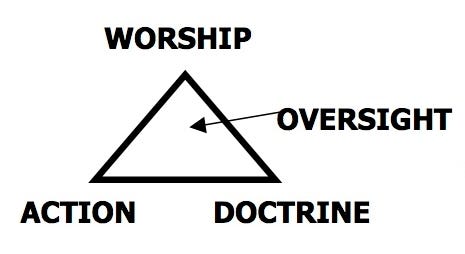
Creating the model
I’ll unfold the model by telling you the process of creating it. This is a best as I can recall.
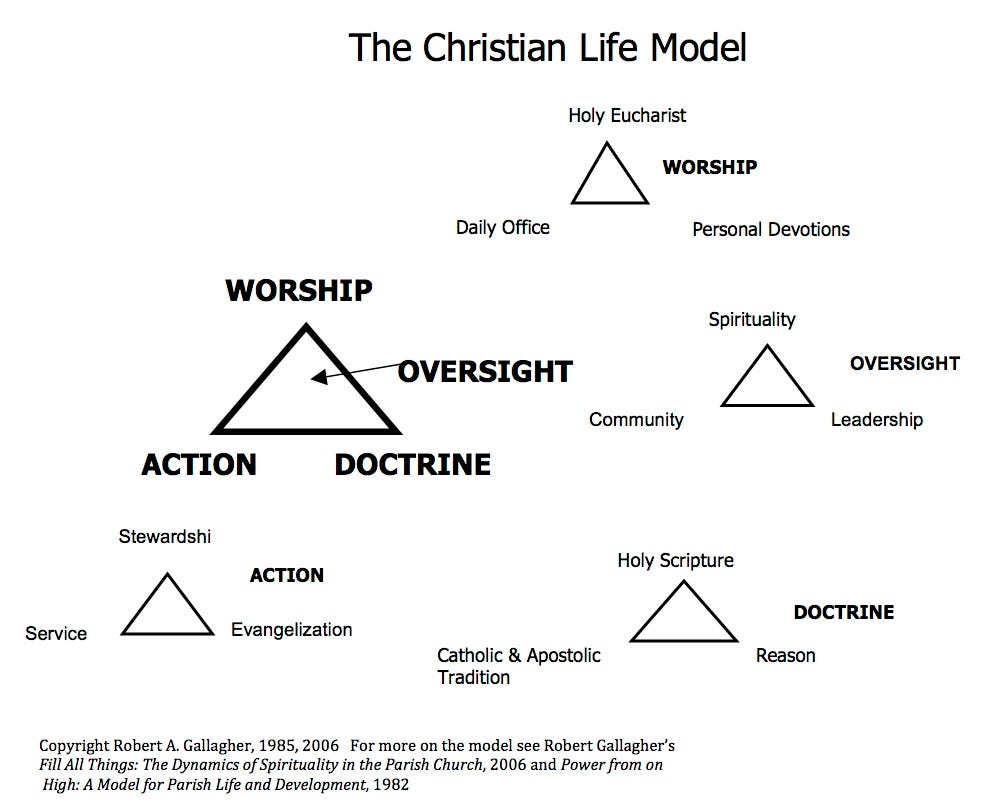
In the early 1970s I was finishing seminary, working at an industrial mission, being ordained a priest, and living in a commune of Episcopalians in West Philadelphia. I had come across the idea of the threefold rule of prayer in Martin Thornton's work: Mass, Daily Office, Personal devotions. I appreciated Thornton’s understanding it as a system of balanced spirituality. Each element serve to offset what was missing in the others. It created a “whole.” The Eucharist was the “Living heart of the Body of Christ.” The Office was the heart’s “continual beat or pulse” and offered an “objectively ‘give’ to God Almighty.” And Personal devotions was “circulation of the blood which gives life and strength to its several members,” was “inspired by the Holy Spirit” and was “that prayer done physically alone, according to ones unique gifts, personality and temperament.” (MORE)

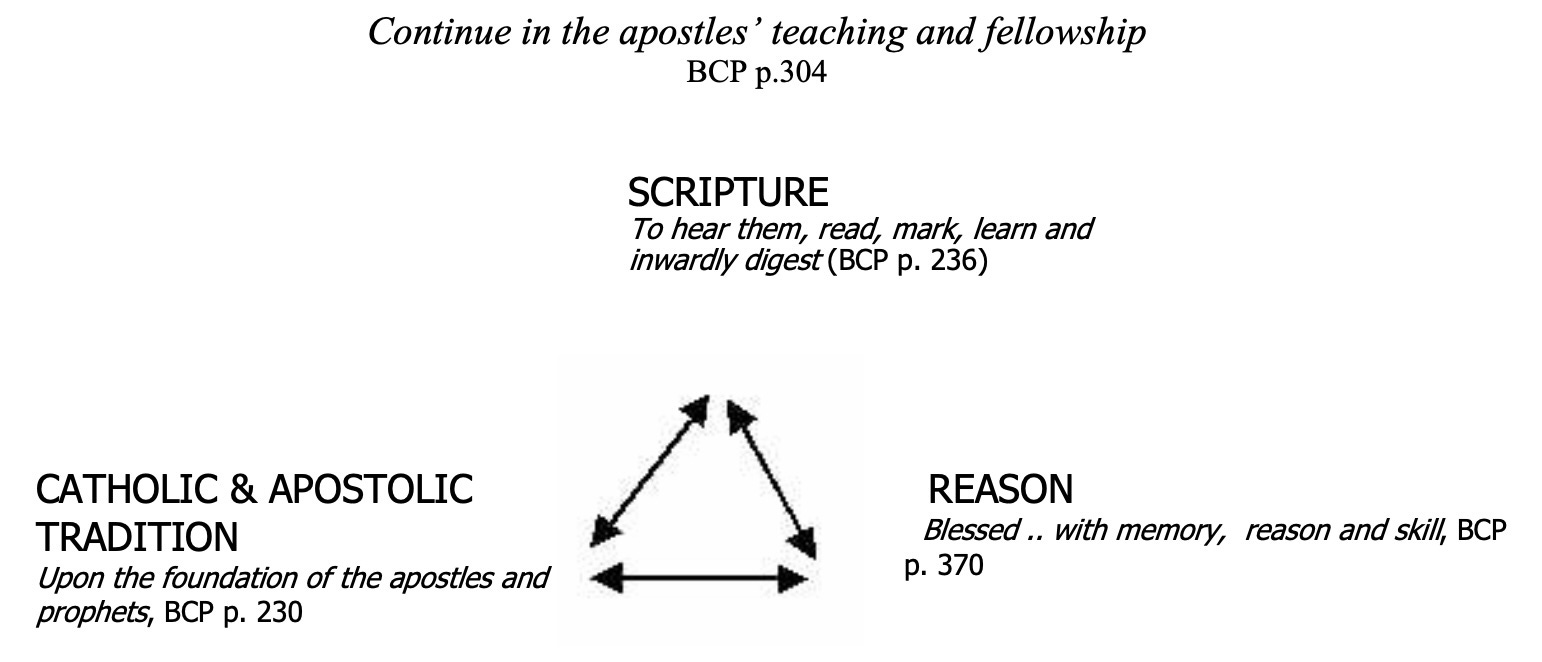
Of course, I was aware of the Anglican tradition’s three legged stool of scripture, tradition, and reason. That fleshed out the doctrine corner of the model. I did have to sort through what around that time was being pressed as a fourth aspect of authority - experience. The phrase “lived experience” is popular at the moment. But truthfully, I can't figure out what kind of experience is not lived. But back then some were saying that experience has authority in our life. And of course, that is true. But the issue is what has Christian authority? It became clear to me that while we self-authorize the value of our experience, for the Christian it is the threefold elements of scripture, tradition, and reason that allow us to best understand, and at times, critique our experience.
Over the years, I have found some people using the model and changing the Doctrine corner to education. That, of course, was a significant misunderstanding of how the system in fact plays out within the church. Education is not a balancing and critiquing force in relationship to worship and action. Education is something you do to advance worship, action, and doctrine.
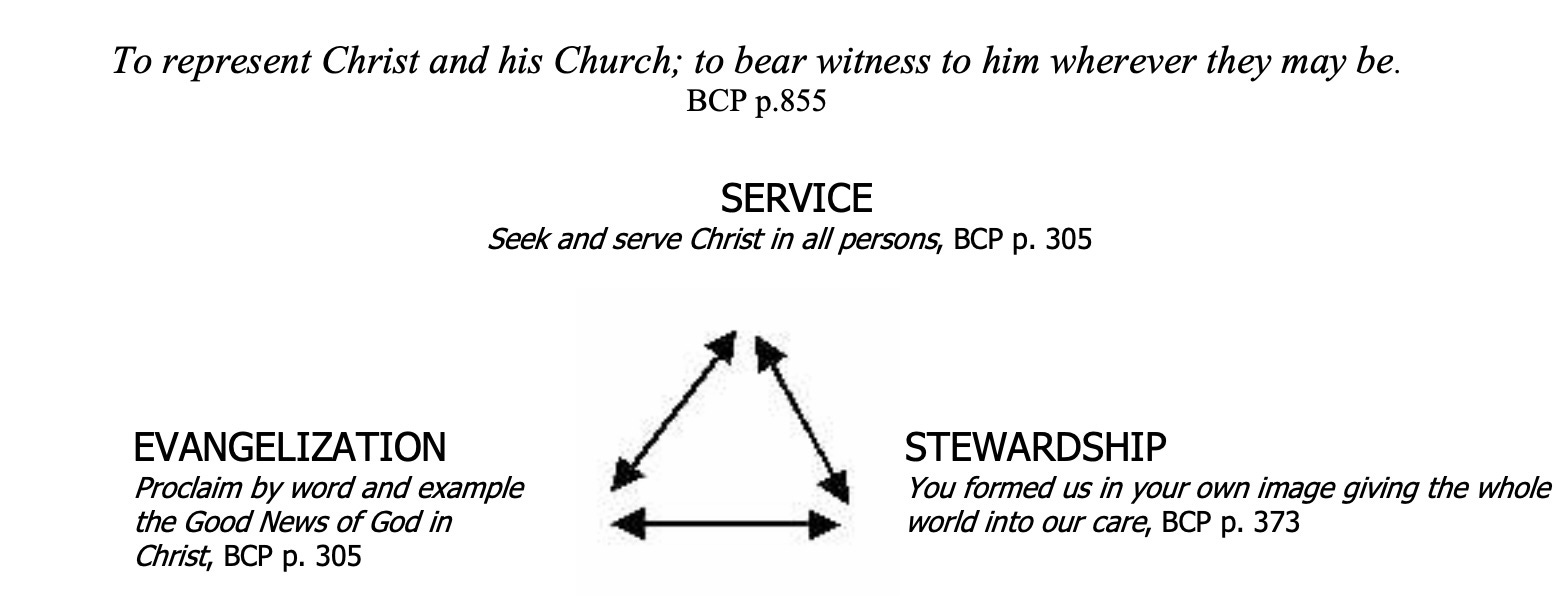
I bounced around a bit as I thought through the Action corner of the model. Two public conversations were clarifying. First, there was an argument going on between the evangelical and liberal voices in the church. One pressing us to work more on what it called evangelism and the other wanting more attention to social justice advocacy. For many of the advocates, it was a zero sum game. My experience in my South Philadelphia parish suggested that evangelization and service were not only compatible but allies. So, the two elements became evangelization and service. I thought that the word evangelization captured my concern more than evangelism. [1]
Working in an industrial mission, put me in contact with American Baptist theologians who thought of stewardship in terms of the care of our world and institutions. Also, in those years, the World Council of Churches was conducting action-research programs, “The Role of Christians within Changing Institutions: Studies on Humanization and Mission.” And there was already a comparable movement in Roman Catholic Church as seen in John XXIII’s 1963 Pacem in Terris: it is not enough for Christians “to be illumined by the heavenly light of faith and to be fired with enthusiasm for a cause; they must involve themselves in the work of [every] institution, and strive to influence them effectively from within.” So stewardship became the third element of the Action corner.
Advocacy then wasn’t a comparable element but an activity that might be generated from any one of the three essential elements of service, evangelization, and stewardship.
Finally, oversight. “Oversight is what knits things together in harmony and beauty. Oversight is expressed in the three threads of spirituality, community, and leadership. They offer richness and depth in worship, doctrine and action. Oversight provides strength and connection for the fabric of Christian life.”

By 1977 I was using the model in a adult formation program, “The Christian Life Course.” In 1982 Ascension Press published Power from on High: A model for parish life and development (a free PDF of the book)
At Lambeth in 1978 the bishop’s spoke of a pattern of life: “This inextricable fusion of worship, of doctrine, and of action constitutes the distinctive contribution the churches of the Anglican Communion desire to make to the Universal Church of God in Jesus Christ.” That confirmed the central elements of the model in my mind.
Fill All Things: The Dynamics of Spirituality in the Parish Church (2008) includes the Christian Life Model as one of the four core frameworks. There is a chapter with the latest version of the model.
Martin Thornton points to it in The Rock and the River and in his description offers a process and systems perspective: “Moral action only flows from doctrinal truth by grace and faith, that is through prayer.”
“Christian Life is life lived in Christ: “Christ in us and we in him.” Christ comes to us and we seek Christ in worship, doctrine and action. Each is a pathway into a transformation of life, directed toward our union with the heart, mind and work of Christ; directed and our becoming a “new creation.”
This abides,
Brother Robert, OA
The Feast of Johann Sebastian Bach, Composer, 1750
Related Resources
The Christian Life Model The Christian Life Model - A video presentation
The Christian Life - short OA tract from the 1980s A worksheet
Christian Life Model assessment - parish
Christian Life Model - Your spiritual life
[1] Evangelism and evangelization are both about sharing the Christian faith. . Evangelism usually refers to the work of proclaiming the Gospel message. We usually think of preaching. Evangelization is a broader approach to sharing the faith. It seeks changed lives and a changed world. There are both inward and outward movements. The inner life is our ongoing conversion, formation, individually, in this parish and the whole Church. It is growth in holiness of life. Externally evangelization addresses people who have not heard the Gospel and those who have drifted away.