
Jewish manipulation
Who can tell how often he offends? * cleanse me from my secret faults.

Let us pray for the Jewish people, who by the grace of their eternal covenant with God were delivered from bondage into freedom; For their continued faithfulness; For their flourishing in peace as witnesses to God’s sustaining love; For their safety from all malice and harm; For their liberation from all forms of antisemitism and hatred; For the fullness of redemption for the sake of God’s Name. That unity and concord may exist between Jews and Christians, in obedience to God’s will. Standing commission on liturgy and music
I want to begin by affirming the changes being made in our liturgy to step away from explicit or implicit antisemitism. Updating and revising translations and Solemn Collects is long overdue. Offering a theologically positive view of God’s covenant with Israel is a good step. [1]
Our Anglican focus on liturgy is something I treasure. It's a gift to the universal church. The danger for us is that as we focus on that we tolerate other forms of antisemitism among us. I want to offer just one place where I think we could do better. I want to look at the ancient antisemitic conspiracy theories about how Jews manipulate the world and suggest behaviors that we as faithful Christians might engage in.
The idea of Jewish manipulation
The idea of Jewish manipulation is conspiratorial antisemitism. It relies on the age-old myth of “Jewish power” and “global control,” which falsely asserts that Jewish people work in secret to manipulate world events, financial institutions, media, and governments for malevolent purposes. Contemporary variants often use terms like "Jewish cabal," “Zionists," globalists," "cosmopolitan elite," or "the Rothschilds". Many see it in the views of people on the right like Tucker Carlson, Candace Owens, Nick Fuentes. On the left mainstream figures condemn antisemitism while watchdogs like the Anti-Defamation League have documented how extreme elements within anti-interventionist and anti-Zionist movements frequently cross the line into hate. Hasan Piker is often mentioned.
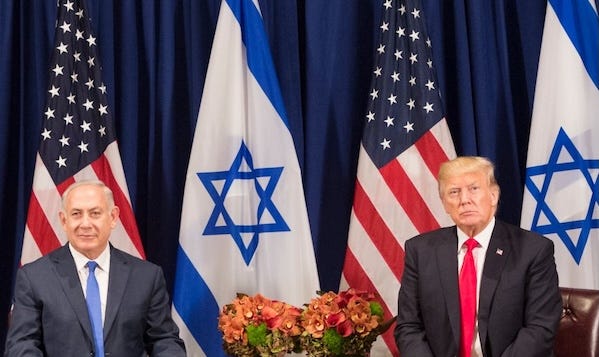
Netanyahu & Trump
There is an ideological battle taking place where commentators on both the far-left and the far-right have been accused of echoing antisemitic tropes by claiming that Prime Minister Netanyahu manipulates President Trump. The danger for us Episcopalians is that as we generally lean to the left politically - 2/3 of us voted for Harris, 1/3 for Trump - and are often very critical of both leaders — we may be too ready to receive a bit of antisemitism into our souls. Those who would manipulate us in that direction work hard to keep our focus very narrow. For example, they will say look at Netanyahu's influence on Trump in starting the war with Iran.
I find within myself the best way of addressing this danger is to look at the big picture, the whole board. What in fact has been going on in the back-and-forth between Trump and Netanyahu? And what has been the historical relationship of American presidents and Israeli Prime Ministers? And what is the history of antisemitic accusations about Jewish manipulation?
The history
Antisemitic accusations that Jews manipulate society originate from early Christian theology. Over the centuries that evolved into secular conspiracy theories about global domination and political subversion.
The base of the manipulation trope is in the medieval Christian accusation that Jews were collectively responsible for the death of Jesus. Jewish people were seen as malevolent and capable of sinister plots. In the 12th century, Jews were falsely accused of murdering Christian children to use their blood in secret rituals, a manipulative subversion of Christian society. During the 14th-century Black Death, Jews were accused of poisoning drinking wells.
By the 19th century European hatred moved into political and economic conspiracy theories. As Jews began to enter professions from which they were previously banned, such as banking and media, they were accused of using these roles to secretly control the levers of power. The “Protocols of the Elders of Zion” was a Russian forgery from 1903 claiming that the Jews had control of economies and the press in an effort to destroy Western civilization.
In the 20th Century conspiracy theories emerged blaming Jewish manipulation for catastrophic world events. Following World War I some defeated German military leaders claimed that Jews had manipulated the home front and betrayed the nation. That then was exploited by the Nazi Party to justify the Holocaust. The theories were often in conflict. Propagandists would accuse Jews of being the manipulative masterminds behind both exploitative capitalism and subversive Communist revolutions.
Today the myth of Jewish manipulation frequently manifests in claims that Jewish individuals or organizations secretly control national banking systems, manipulate government foreign policy through dual-loyalty accusations, or orchestrate major global events. You can find resources on how these tropes have been used in propaganda - here and here.
The relationship of American Presidents and Israeli Prime Ministers
I was 12 years old when the 1956 Suez Crisis unfolded. It was also the year of the Hungarian Revolution and the Supreme Court decision declaring segregated seating on buses unconstitutional. [2] My interest in history and political science was activated.
Egypt had nationalized the canal. Britain and France feared this would threaten their access to the canal. They secretly allied with Israel to invade Egypt. President Eisenhower opposed his allies. He used financial pressure and United Nations action to force their withdrawal. This also had an impact on their standing as independent superpowers. The president was driven by concerns of Arab nationalism and Soviet intervention. Israel felt deeply frustrated and betrayed by Eisenhower’s act. Israel was forced by Eisenhower to completely withdraw from the Sinai Peninsula without securing its primary goals of lasting border security and free maritime passage.
That early event illustrates the general historical consensus that since 1947 the American president ultimately wields the upper hand. The US leverage is rooted in arms supplies, financial aid, and U.N. veto power. When U.S. presidents—such as Barack Obama, George H.W. Bush, or Donald Trump—firmly press an issue or withhold certain political favors, Israeli leaders are often compelled to compromise or alter their tactical course However, Israeli Prime Ministers frequently exert reverse influence by leveraging domestic U.S. politics, such as evangelical or congressional ties, and acting to force Washington’s hand in the Middle East.
The balance of influence has gone back-and-forth over many decades. There have been times of collaboration and other times of friction. It was also in 1956 that in one of the earliest major intelligence coups of the Cold War, Israel’s Shin Bet acquired a copy of Soviet Leader Nikita Khrushchev’s secret speech. Prime Minister David Ben-Gurion authorized sharing it with the CIA. That solidified a foundational intelligence sharing bond with the Eisenhower administration. Another example comes after the 1967 Six-Day War and following War of Attrition, Israel had captured advanced Soviet military technology during the wars. Israeli Prime Ministers transferred these to the U.S. military, allowing American engineers to successfully reverse-engineer Soviet capabilities.
There have also been significant frictions. For example, in 1981 Ronald Reagan briefly cut intelligence cooperation and delayed aircraft shipments after Israel bombed Iraq’s Osirak nuclear reactor without giving the U.S. prior notice. In 1991 George H.W. Bush delayed $10 billion in loan guarantees to Israel to pressure Prime Minister Yitzhak Shamir into halting the expansion of Israeli settlements in the West Bank and to secure Israeli participation in the Madrid Peace Conference. During the Clinton administration we saw both the carrot and the stick. In 1993 Clinton worked behind the scenes to delay and block a UN Security Council vote on sanctions against Israel regarding the deportation of Palestinian activists. In 1996 he pressed Israel into an accelerated ceasefire agreement to halt the military campaign against Hezbollah in Lebanon. In 2024 President Biden paused a shipment of thousands of heavy bombs to Israel to signal opposition to a major military offensive in the densely populated southern Gazan city of Rafah.
The back-and-forth between Trump and Netanyahu
There is currently a lot of discussion about how the Israeli Prime Minister uses praise to influence Donald Trump. And it's true that praise is one part of the picture. But as you look at the big picture, you see something more. They share a transactional relationship, often leveraging one another for domestic political survival. Netanyahu has influenced Trump in several ways. He pushed Trump to withdraw from the Iran nuclear deal and has consistently shaped U.S. threat assessments regarding Iran's nuclear program. In Trump’s first term, he used Trump’s desire for historic "wins." He secured major U.S. actions such as the recognition of Jerusalem as Israel’s capital and Israeli control over the Golan Heights. He caters to Trump's need for validation by offering lavish praise.
Trump has also influenced Netanyahu. Trump mostly dictates the parameters of Israeli military actions to fit U.S. foreign policy goals. Trump pressured Israel to accept ceasefires and restrained Netanyahu from unilaterally striking targets. Trump has publicly asserted dominance in the relationship, telling the Financial Times that he, not Netanyahu, makes the decisions. Trump even acknowledged using expletives during a tense phone call with Netanyahu regarding Israel's strikes in Lebanon. Trump’s public pronouncements significantly influence Israeli domestic media and politics. While Trump has lobbied for Netanyahu to be pardoned on corruption charges, he also uses his public platform to remind the Israeli public that they need Washington, turning the alliance into a tool for projecting power.
In summary, the back-and-forth between Trump and Netanyahu regarding military actions from 2016 to 2026 has been defined by a shifting dynamic of public alignment, hidden friction, and direct clashes over regional escalation. While the two leaders historically positioned themselves as close ideological partners, their strategic military objectives have frequently diverged.
The most recent events illustrate the tension. In the 2026 War on Iran Trump and Netanyahu initially acted in lockstep coordinating on devastating strikes that targeted senior Iranian leadership. Then their long-term goals rapidly diverged. Trump prioritized a quick exit, trying to broker a comprehensive peace deal to stabilize global energy markets and prevent an extended Middle Eastern quagmire. Conversely, Netanyahu pushed to sustain heavy military pressure to dismantle Iran’s ballistic missile programs and bring down its government. As I write, this is all in motion. Trump appears to be wondering if he has been played by Iran and his desire for a quick deal.
A Christian response
Don't drift from a specific objection to an act of antisemitism
If you don't like Donald Trump, Benjamin Netanyahu or the behavior of either of them, that's fine. If you think Israel went too far in Gaza, that's fine. If you think the war with Iran was a mistake, that too is fine. However, what I've noticed in many comments online is a practice of quickly shifting from what the person says they find objectionable to universalizing it into a story of Jewish power and manipulation.
Keep the big picture in mind
For many decades, we Episcopalians have known that there's been objections to portions of the Good Friday liturgy. The readings or a prayer with reference to the Jews were used year after year, even though we knew how hurtful they were to our Jewish neighbors. Many of us would want to ignore the actual impact and focus on our intention. It was not our intention to feed antisemitism so year after year we would continue the practice. Finally we seem to come to terms with the reality that what many people were experiencing fed their antisemitism.
There might be a comparable act of kindness and humility called for when we are inclined to go along with the idea that the true narrative is that Netanyahu, the Jew, is manipulating Trump. When the fact is that there is a two way, transactional, codependent activity, taking place. Frequently it is Trump dominating the discussion and actions. If we just go along with that false narrative, the impact is the feeding of antisemitism within ourselves and others. So we need to publicly acknowledge the complete truth, not just the part that feeds our frustration or anger.
Repentance
The game is, the sin is — trying to claim that this time is different. One of the spiritual dangers that those of us who lean in a more liberal or progressive direction face is that we assume we are always morally correct. Now, if someone puts it that way, we of course deny it. But just as so many evangelicals collapse their political views and their religious faith so we, of the other persuasion, also have our own way assuming the alliance of our faith with our politics.
We may acknowledge the long history of the antisemitic trope regarding Jewish manipulation of the world. And having acknowledged that we will go on to claim that this time is different and complain about Israel’s influence, or about the Jewish lobby in the United States, or some example about the Israeli Prime Minister convincing the American president to do or not do something. We are the good people so we can't be involved in antisemitism. It's not possible that we are continuing in our own time the same ancient anti-Jewish trope. If we are challenged, we will justify our complaint in some manner. Usually it involves avoiding any acknowledgment that we are engaged in a double standard. The fact is that all our allies influence us. And many ethnic and religious groups have lobbies in Washington (including us Episcopalians). And there's all sorts of evidence about the times when the Israeli Prime Minister was unable to convince the American president about anything. And of course, in the bigger picture there's the fact that the heads of other nations routinely work to influence the American president. So when we find ourselves obsessing about the Jewish or Israeli action when we do not raise the same concern in regard to all the others, that is a double standard. And a double standard is classic antisemitism.
The Christian remedy in the situation is repentance. Stop what we're doing and move in a different direction.
Take on gestures of Christian-Jewish solidarity
There are a variety of things being done by individual Christians to show solidarity.
Wearing symbols - such as the Star of David or a Chai - alongside Jewish peers to visibly challenge the normalization of hate.
Stand against local vandalism and neo-Nazism display mezuzahs on their own doors. Place a menorah on your window during Hanukkah (more).
Make use of a product or service of a Jewish owned business when there has been an act of violence or hostility toward that business.
Who can tell how often he offends? * cleanse me from my secret faults.
Above all, keep your servant from presumptuous sins; let them not get dominion over me; * then shall I be whole and sound, and innocent of a great offense.
Let the words of my mouth and the meditation of my heart be acceptable in your sight, * O Lord, my strength and my redeemer.
(From Psalm 19, today's Evening Prayer)
This abides,
Brother Robert, OA
Parish development - Social ethics - Spiritual life
[1] Our offering a theologically positive view of God’s covenant with Israel is a step against our long time tolerance of explicit and implicit antisemitism. It aligns us with the views of most Jews. It's not exactly the same issue except in many ways it is — The vast majority of Jews see the modern State of Israel as deeply connected to the ancient biblical and historic state of Israel. This bond serves as a central anchor for Jewish identity. There are also diverse interpretations regarding its religious and political meaning. I find myself wondering why the 81st General Convention needed to attack the way Jews see themself. I'm not aware of any Jewish conventions doing the same to us Episcopalians. If the convention felt that the current state of Israel was engaged in actions that are unjust, why not just say that?
[2] the Supreme Court decision declaring segregated seating on buses unconstitutional also ended the historic 381-day Montgomery Bus Boycott and propelled Dr. Martin Luther King Jr. to national prominence.
The picture is a work of an employee of the Executive Office of the President of the United States, taken or made as part of that person's official duties. As a work of the U.S. federal government, it is in the public domain. President Donald J. Trump and Prime Minister Benjamin Netanyahu of Israel at the United Nations General Assembly (Official White House Photo by Shealah Craighead) Date2 October 2017
RELATED