

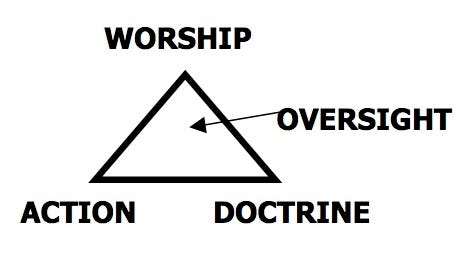
One method for assessing our spiritual life is to use frameworks or models. In some cases a model commonly used in parish self-assessments can be applied as we reflect on our personal practice. Such use has value in itself and when used broadly in a parish for both self-assessment and parish development purposes we create a denser parish culture with a common language for understanding and engaging our life together. Over time I’ll be offering several such frameworks. Those articles will address both the particular aspects of the spiritual life the model is about as well as issues in using the material as an adult formation resource in parish life. I’ll begin with the Christian Life Model.
The Christian Life Model
To get started I suggest you download two PDFs. There is the worksheet itself and a four page explanation of the model. You can use both PDFs in parish formation programs.
Begin by filling out the worksheet. Do a self assessment of your spiritual life. If you’re considering offering a parish program using the worksheet there are two primary reasons for doing it on yourself before using it with others.
It’s sound professional practice. Doing a dry run allows us to anticipate difficulties others may experience as they complete the assessment. As you fill it out note how that occurs at two levels. One is in the worksheet itself. There may be unfamiliar practices, concepts, and words. The other is our inter struggle with being willing to honestly look at our spiritual life. It's the struggle between stability and change, in Benedictine terms, stability and conversion of life. In Seeking God Esther deWaal wrote, “Stability means that I must not run away from where my battles are being fought, that I have to stand still where the real issues have to be faced. … and conversatio, openness, means that I must be ready to pick myself up, and start all over again in a pattern of growth which will not end until the day of my final dying.”
It's an act of humility. It is engaging your own strengths and weaknesses before asking others to do the same. Self awareness involves seeing and accepting our own sin and human limitations. Doing our own self assessment makes us more open to hearing feedback from others.
“In what ways do I want to experiment with or change these practices?”
That question is asked several times on the worksheet. It may be a new thought for many people. Making decisions to change our spiritual discipline or to experiment with a new practice for a time, is a tangible expression of accepting responsibility for our spiritual life. The very notion of being responsible as an adult for our spiritual life will come, to some, as a great surprise, and they may need guidance to take it in. Seeing experimentation as part of how we are to engage our spiritual life may reduce our fear of failure, and help us approach it as a learning opportunity.
As it is a new idea for many, a bit of training and guidance may be useful. A priest or catechist might lead people through the process.
What are you thinking of doing? What are you seeking in that? For example, “If I begin to intentionally engage my body in acts of worship by bowing, kneeling or using the sign of the cross, I may develop a stronger inner reverence.
Ask the person to make a decision about how they will engage the practice, what they will do and for how long. Being able to competently perform the practice will increase the person's commitment to it. And it's important to consider how long a period of time is necessary for this particular practice to be experienced and reflected upon.
Do it with others. For many of us, it's easier to take on a new practice as part of a group.
Explore the possible results in advance. We want to encourage people to measure this by whether they learn something about themselves, others, and the ways of God. That means stepping aside from seeing it as some kind of test or contest in which they must be successful.
Integrating Life
When we use the Christian Life Model in parish development efforts we use the word “oversight” to talk about how to harmonize the primary elements in a whole and unified parish life through leadership, spirituality, and community. When using the model with individuals we speak of how to integrate our spiritual life by way of developing a rule of life, life in a Christian community (the parish church) and openness to guidance.
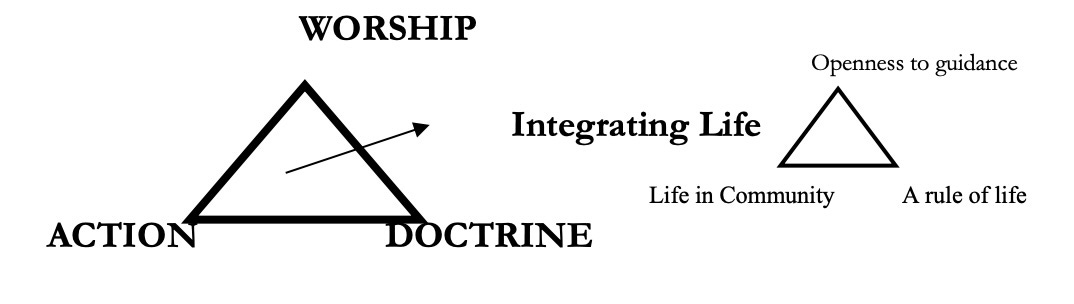
Openness to spiritual dependence and guidance is taking a stance of receptivity to the notion that for all eternity I am called to growth in God’s love and service; and a willingness to have some setting for exploration of and guidance in the spiritual life.
Establishing a rule of life is how we give ourselves to an intentional pattern of Christian discipline which expresses the faith and practice of the wholeChurch in our own lives.
Life in Christian community is how we give ourselves to a specific expression of the body of Christ. We need to be part of a parish church, a particular community of the People of God who worship, learn and act in Christ.
In an adult formation program you might want to provide a way for people to explore these three aspects of integration. Have a 1 to 6 scale assessment of each item and a brief discussion. Or after a presentation on the three elements, go around the room and provide an opportunity for each person to share what comes easiest for them and what hardest, or possibly what draws them toward one and what one seems most challenging.
An invitation and challenge
In using any model that is grounded in Anglican aesthetically theology will bring people up against unfamiliar practices, concepts, and words. Some people are energized by the nervousness of it. Others are more resistant and may be fearful. Hearing about lectio divina may disturbed some. Others might be resistant to thinking about evangelization, storeship, and service in relationship to their friendships.
Those of us leading adult formation programs need to take care to provide psychological safety, but never remove elements that people might find uncomfortable or challenging. Adequate psychological safety helps people manage their anxiety. It’s not an attempt to get people to feel comfortable but about them being willing to be responsible participants. Most people are helped by having the program offer clear structure and steps. Reliable structures and norms, used routinely, tend to produce psychological safety. And that results in increased directness and freedom of expression. And valid and useful information produces free choice and free choice produces internal commitment (Intervention Theory). It is the opposite of the kind of safety we see in many places that reduces the willingness of people to share what they actually think and feel. Psychological safety is about freedom and productivity not about being comfortable.
By the waters of Babylon we sat down and wept, *
when we remembered you, O Zion.
As for our harps, we hung them up *
on the trees in the midst of that land.
For those who led us away captive asked us for a song,
and our oppressors called for mirth: *
“Sing us one of the songs of Zion.”
How shall we sing the Lord’s song *
upon an alien soil?
Psalm 137 -from today’s Morning Prayer
This abides,
Brother Robert, OA
Find more on the Christian Life Model in Fill All Things: The Spiritual Dynamics of the Parish Church Related PDFs The Christian Life Model - The Christian Life Model, A video presentation — Christian Life Model Core Elements - Christian Life - common errors - Christian Life Model assessment for the parish - The Christian Life Model, the process of creating it
Sister Michelle, OA has used a one session program helping people do this self-assessment and develop their rule of life. See Chapter 3 in Nothing So Contagious as Holiness: Developmental Initiatives for Increased Parish Vitality Grounded in Spiritual Practice